







August 19, 2004

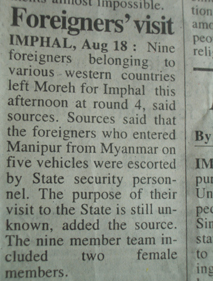
[This morning, we were delighted to see this clipping in the local Imphal paper. It's fun (and a little bit eerie) to read people's speculation about our intentions here in India...]
Bear with me, if you will. Today is my journal day, but I am, again, swamped with a lot of other writing to accomplish. I spent the day working on the below press release. It didn't make the cut, but I think it's good enough for publishing here on our blog page. And, anyway, it'll explain some of what we accomplished by transiting Myanmar. --N.O.
MOREH, INDIA, Aug. 19, 2004--We have carnet stamps on our passports, which means we have officially crossed Myanmar, said LONGITUDE Expedition leader Nick yesterday.
His Drive Around the World non-profit organization?s third expedition is the only continuous overland journey to cross the former country of Burma in more than 50 years.
The eight-member volunteer team left northern Calif. Nov. 1 last year to begin a yearlong expedition around the world to raise money for Parkinson?s Disease research. Since then, they have traveled more than 22,000 miles across twenty countries and four continents to arrive here at the India/Myanmar border town of Moreh. Their longitude route brought them from the U.S. to the tip of South America, across Australia, and up through Singapore, Malaysia, Thailand, Cambodia, Laos, and China. By driving their four Certified Land Rover Discovery expedition vehicles across Myanmar from the Ruili, China, border in the west to the India border in the east, the team has placed their drive-a-thon in the history books.
This milestone comes with the sense of accomplishment that accompanies only the most hard-fought of achievements.
Myanmar is a country that is perhaps the most strict when it comes to tourism, and especially vehicle travel. Planning this has been my Moby Dick since the beginning, said Nick, 36, of Los Gatos, Calif.
Myanmar's arguable politics, its tourism restrictions, and a near absence of good, navigable roads have made it all but impossible for foreigners to drive their own vehicles across the country. Much of the difficulty lurks at the borders of this tiny, former British empire. The team spent one month in Bangkok visiting embassies and working with agents to prepare the intense paperwork for the China-Myanmar-India leg of their expedition. Transiting Myanmar hinged on the expedition?s success in first securing China permission, India permission, and finally Myanmar permission.
?s to Myanmar, it?s basically impossible to drive into! We ended up shipping
from Bangladesh to Malaysia, warned an expedition contact in an e-mail to Nick. His team didn?t even bother trying.
In 1953, a team of Cambridge University students drove two Series Land Rovers through Burma during a record-setting drive from London to Singapore. Their east-west crossing of Myanmar was the most difficult leg of their (however-long) journey.
In Feb. of this year, a Swiss couple was turned away at the China/Myanmar border in Ruili when their India Border permits failed to come through. They were forced to drive back through China to Bangkok in defeat.
Before that, Londoner David Burleson made it all the way across Myanmar to Tamu, Myanmar?s India border town, before he was denied entry to India for failure to obtain the required Protected Area Permits for that country. He left his car in Myanmar and returned to London.
Burleson was exploring shipping options when he found out about the Swiss couple?s intentions.
?I decided to wait and see if I could join up with another group who got the permit,? said Burleson. When the Swiss expedition failed, he began to give up hope. ?I was just hoping that something would turn up, and then [Drive Around the World] came along.?
When the LONGITUDE Expedition contacted him through networking channels, Burleson had his opportunity. Admittedly still skeptical, he bought a ticket to Yangon, Myanmar, and flew out when the team?s permits came through. Nick and his team met Burleson east of Mandalay and began driving together toward India.
But not even Drive Around the World was without its trials.
"Tomorrow from 2:00 p.m. to 6:00 p.m. China time will be the most difficult hours of our expedition", said Nick in an e-mail to supporters upon his team?s approach to the China/Myanmar border town of Ruili.
Their China carnets, or vehicle passports, were about to expire on their Land Rovers. A delay in the India permit office trickled over to a delay in obtaining Myanmar permits, and that meant the team would be in limbo in China for one week until their guide could meet them with their permits to drive into Myanmar. Because of their desire to prevent what had happened to Burleson from happening again, Myanmar officials abstained from stamping the vehicles into their country until they knew the convoy would not be turned away at the border to India.
"At this border, the traditional policy, when paperwork is not ready for Myanmar, is to force the group to turn back to the China point-of-entry which, for us, means they will force us to drive five days back to Laos," said Nick's Aug. 5 e-mail. ?I have read accounts of two groups who have recently experienced this most-frustrating case, and, without official paperwork, we are poised to be the third.?
The team reached the China/Myanmar border, amidst a cloud of uncertainty, on the day that their vehicle permits were to expire. The plan was to attempt to convince the Chinese to store the vehicles in impound while the team waited in China for their Myanmar paperwork to arrive.
Fate sided with the team, and they were greeted by smiling and accommodating Chinese customs officials and border police, who were more than happy to help a group of American adventure-philanthropists. The team was granted an extension to keep their vehicles in the country until their Myanmar transit permits were ready.
On Aug. 14, a joyful group cleared Chinese customs and met their Myanmar guides in the border town of Muse. That was the beginning of what they agree has been some of the most beautiful and most difficult driving they have experienced during nine-and-a-half months of world travel.
Their route brought them west along the historic Burma Road, past where it intersected with the old Stillwell Road, through the capital city of Mandalay, and north along the India-Myanmar Friendship Highway to India's border.
The Burma Road extends about 700 miles from the railhead of Lashio, Myanmar, to Kunming, the capital of Yunnan Province of China. Built by the Chinese as a military supply route in 1937-1938, it was used by the Allies during the early months of World War II. From its opening in 1938 to about May of 1942, more than 490 thousand tons of strategic materials, 10 thousand automobiles, and 90 thousand armed forces were transported to the front lines across rugged mountainous terrain.
In 1941, before the U.S. declared war on Japan, a small squadron of American fighter pilots, nicknamed the ?Flying Tigers? by the Chinese, secretly set up a base of operations in Kunming. While protecting supply planes and patrolling the Burma Road, the Flying Tigers flew their P-40 fighter aircraft back and forth over a portion of the very route the LONGITUDE team traveled.
In April 1942, the Japanese captured Lashio and closed the road. The Allies constructed an alternate supply route, which originated in Ledo, a railhead in Assam, India, and crossed northern Myanmar to connect to the Chinese portion of the Burma Road, named Stilwell Road in honor of the American general Joseph W. Stilwell. After the war, the road fell into disuse, and today it is overgrown impassable to vehicle traffic.
Crossing the point where the old Stilwell Road crosses the Burma Road, the team said they were struck by the area?s historic significance and America?s place in it. This area where young American fighter pilots used to patrol now rarely sees westerners. It is a country where ox-driven carts and big-wheeled steel bicycles are the standard means of conveyance. Water buffalo, not tractors and Peter Builts, are the primary beasts of burden.
The team relied on quick reflexes and well-honed driving skills to avoid bikes, chickens, dogs, children, and ox carts on the narrow roads. Beyond Mandalay, the crowded, narrow streets dwindled down to remote, bumpy dirt paths, and beyond those paths lay what amounted to mud slicks and switchbacks. It took the team 16 hours to travel one 160-mile stretch of ?good road? through Myanmar?s center.
?If this is the good road, I?d hate to see the bad one,? said team member Chanda, 32, of Visalia, Calif.
Along this year-old road that replaces a portion of the old Burma Road, the team had to perform more than six vehicle recoveries and await the repair of a bridge that had fallen as the result of heavy rains. The LONGITUDE team winched Burleson?s Isuzu Trooper once and towed it out of thick mud twice, winched a Burmese military Jeep that had become bogged down in the mire, and yanked a Chinese-built transport bus full of passengers on their way to Mandalay out of a muddy rut with their 9,000-lb. WARN winch.
?My heart is beating faster than it usually does,? said a team member after crossing a precarious bridge. ?That means it?s a good driving day.?
At 2:30 a.m., the team finally hit pavement at the start of the north-south India-Myanmar Friendship Highway, which was built by the Indian government. Beautifully paved, the narrow road is spotted with constant friendly reminders to drive safely. ?Better late than never,? read one. ?Driving with care makes accidents rare,? and ?Life is a journey; complete it,? read others. One that reads, ?Remember your wife and children; drive slow,? reminded the team?s two female members that women drivers in Myanmar are, indeed, a rarity.
In the remote backyards through which the team has traveled, everything about them is a rarity, from their flashy Land Rover Discoverys, to their language, to their physical appearance.
?I didn?t make anybody cry when I got out of the car today,? said team member Justin, 31, of Wichita, Kansas. At 6?3?, this blue-eyed blond is the physical opposite of his new Burmese friends.
The majority of people in the remote areas have likely never seen westerners before, and there is almost no chance they?ve ever seen one driving a personal vehicle.
?They?ll probably still be talking about you months from now,? said Mr. Chetry of Journeys tour company, the team?s Myanmar guide.
The team said they won?t soon forget Myanmar, either.
?I have a feeling several of us will be back,? said Chanda.
Next, the team will drive through Imphal, India, under armed escort, on their way to the flood-damaged state of Assam. From there, they will travel through the Himalayas to Kazakhstan and Russia, before making the home stretch through Alaska and Canada . They are due home in Los Gatos, Calif., in December.
P.S. - The sun rises early here, and this morning?s first light began at 4:30 a.m. The team completed some paperwork and exchanged money before departing under armed police escort. An early fuel stop took several hours, because the pumps were empty. The team had to filter the gas while siphoning it from a container to the tanks. The team entered the tribal area of India known as Nagaland in the evening. The settlers here are originally from Mongolia, and they were Christianized by American missionaries many years ago. They do not consider themselves a part of India, and they are struggling for independence. There has been a ceasefire for more than five years, but past insurgencies and their accompanying bloodshed make the area unsafe and volatile. We had to stop at the South Nagaland police station and apply for a Protected Area Permit to drive in this area, which is under police protection. We had a good time hanging out with the police and learning traditional folksongs and dances from them. They will remain with us throughout our stay in Nagaland. (N.O.)
| Logbook for August 19, Day 293 | ||
|
Start: Imphal, India Time: 11:00 a.m. N: 24* 48.627 E: 93* 56.218 |
Finish: Kohima, India Time: 8:45 p.m. N: 25*39.445 E: 94* 05.881 |
Mileage: 000 |
August 20, 2004
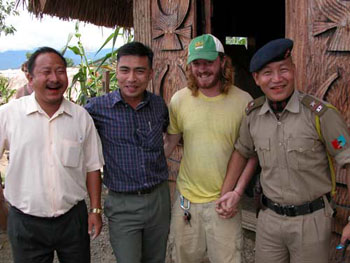
[Above, Colin attempts a traditional Naga dance with his new friends. TT is to the right of Colin. Below, TT salutes in his new Land Rover Certified hat.]

Leaving Imphal with our escort, we began climbing the hills toward Nagaland, another completely untouristed area of India. As we crossed the border from Manipur to Nagaland, we picked up yet another military escort, who took us the final thirty or so miles to the city of Kohima, a rambling city sprawled across a huge valley, and the site of the spot where the English stopped the Japanese on their Indian advance. Nagaland is a fascinating area, inhabited, not by Indians, but by more than fifteen different tribal groups. Understandably, they want to break away from India, as they are definitely not Indians; they look more like Chinese people, and were one of the last groups of headhunters in the world. (They originally settled here from Mongolia.) I managed to pick up a sweet monkey skull headhunters necklace, which is probably the coolest thing I?ve purchased on this entire trip.
Our escort immediately took us to South Police Headquarters, where we were told by some very enthusiastic officers that we were ?being detained.? At first we were a little confused, not really knowing what to do. All these interesting guys were asking us questions and waving guns around, but after about half an hour when they pulled Neil out of the car and taught him how to do a Naga tribal dance, we realized that they were great guys.
Over the next two days, we developed a great friendship with the officers of the South Police Headquarters, as they guided us around their area to a bunch of stuff we didn?t really want to see that much, but were forced to visit anyway, like the war cemetery, which actually turned out to be very moving. Most notable of the crew were Yap and Titi, the second and third in command. Titi was a hilarious guy, basically a clown, always dancing, singing, and goofing around. He spent basically the entire weekend with us and was an endless source of amusement for us all. Yap was also a great guy, although a little harder to read that Titi. Yap was one of those guys who when you first meet him, you think he wants to punch your lights out, but then after some time you realize he?s really a great guy. We spent two nights hanging out with the guys, with Yap and Todd alternating on Neil?s guitar, rocking out to Beatles? songs. Leaving was sad, but as usual, it was a necessity, as Varanasi and Delhi called our name.
P.S. - After a paperwork delay in the morning, the team visited a hill tribe summit village, where 16 Naga tribes convene once a year for the ?Hornbill Festival.? After a quick lunch, the team visited a local market in Kohima before going to the war cemetery, which commemorates the victory of Indian, Nagan, UK, and U.S. troops against the invading Japanese Army in 1944. It was touching to see the plaques dedicated to the hundreds of young men who died in that battle. (N.O.)
| Logbook for August 20, Day 294 | ||
|
Start: Kohima, India (Nagaland) Time: 10:45 a.m. N: 25* 39.445 E: 94* 05.881 |
Finish: Kohima, India Time: 6:00 p.m. N: 25* 39.445 E: 94* 05.881 |
Mileage: 015 |
August 21, 2004
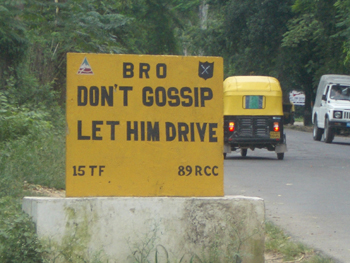
[A street sign warning wives to keep quite so their husbands can drive lends insight to the frequency with which women in India actually sit behind the wheel themselves. Nancy and Chanda receive many curious looks when people see a Discovery expedition vehicle being piloted by a woman.]
Completed crossing of Nagaland and bid our escorts a sad farewell at the border with Assam. The team continued to Guwahti, dodging such obstacles as cows, goats, bikes, chickens, buses, trucks, pedicabs, and people. In Guwahati, the team met up with Take Me With You! guest Matt Candelaria, who will be our teammate for the next month or so. Welcome aboard, Matt. You?re a breath of fresh air! (N.O.)
| Logbook for August 21, Day 295 | ||
|
Start: Kohima, India Time: 6:30 a.m. N: 25* 39.445 E: 94* 05.881 |
Finish: Guwahati, India Time: 7:40 p.m. N: 26* 103.798 E: 91* 44.898 |
Mileage: 255 |
August 22, 2004
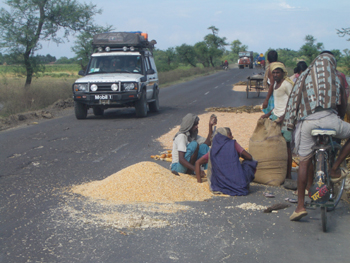
[Roads here in India are ridiculous. The going is slow, because obstacles are rampant. Hazards include bomb-crater-sized potholes, speed bumps, bicycles, ox carts, sacred cows, goats, tuk-tuks, pedicabs, kids, people pooping on the road, buses and trucks and cars coming right at you in YOUR lane, and people drying corn in the middle of the road.]
Hello all, this is Matt Candelaria, drive around the world take me with you guest Number 13. Lucky me. The drive around the world team instructed me to head for Guwahati, India, on the 18th of August. They tell me they should arrive to pick me up on that day at the earliest, but probably a few days later. Turns out a few days later is more correct. I guess they have been having a hard time driving through Myanmar and the Manipur/Assam states of India. They have warned me they might not be able to get to Guwahati because of all the monsoon flooding, so I am of course worried. My only way of contacting them is via email every day, so the Internet cafe is my friend. It is also a way for
me to reach back to the world old world I knew only a few days ago. This is my first trip to India, and it is truly a different place. I am also very afraid of strange foods, so I am not happy. I seem to have found comfort in Lays potato chips and Coca Cola. The last few days have been chips and Coke for breakfast/lunch, and a roll of the dice for dinner at the various "nicest" hotels that seem to have some attempts at international cuisine. One has some Chinese food that I am finding tasty. I continued my wait, and finally three
days later on Sunday evening the team arrived. The car doors slamming in the parking area below my hotel room woke me, and now this wonderful journey is about to begin for me. I can't wait!
P.S. - Team rolled early to begin marathon haul to Varanasi. Team made good time in the early morning, but pace slowed later in the day. At one point, we mistook a man sleeping on the road for a dead body. Nick led a small team to the border of Bhutan while others drove on to Guwanat. Team witnessed recent flood damage in Assam, including villages underwater and displaced civilians living in makeshift shacks along the roadside. (N.O.)
| Logbook for August 22, Day 296 | ||
|
Start: Guwahati, India Time: 6:20 a.m. N: 26* 103.798 E: 91* 44.898 |
Finish: Siliguri, India Time: 8:37 p.m. N: 26* 43.969 E: 88* 24.716 |
Mileage: 276 |
August 23, 2004
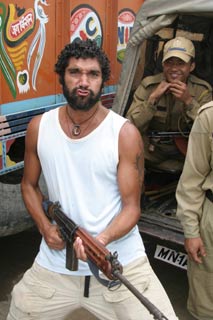
[Rambo, err, I mean, Neil, gets rowdy with a weapon in India. This Marine has never been so scared. Muzzle awareness, Neil! Muzzle awareness!]
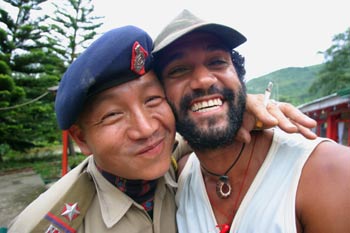
[Neil and his new best friend, TT, from Nagaland. These two were inseparable!]
Now I feel like we are in India!! We have been in "India" for many days now, yet we were in the two states of Manipur and Nagaland, which are not very "Indian" at all. The ancestry of the people who live in those states is from Mongolia and the greater China area. They do not have Indian customs or blood and are very different, which is why they are fighting for their freedom from India. I really grew to adore Nagaland, especially since we became really good friends with the military police there and had some fantastic times. Titi, one of the Nagaland police chiefs, was a hilarious character, and I already miss him. He convinced me to become a military officer myself, and it seemed to fit my personality quite well, especially with a fat gun in my hand!!
But that was then, and this is now. We entered the state of Assam a couple days ago, and have been driving across it very slowly. Once we came out of the mountains of Nagaland, we entered the flat and partly flooded plains of Assam. Once we crossed the border, India was in our face and has been ever since. It is difficult to describe India in words that really do it justice; you really need to come here and experience it first hand.
First of all, if you think driving in the city during rush hour traffic is bad, try to imagine all those cars being replaced by thousands of people, cows, dogs, pigs, auto rickshaws, dust, squatters on the side of the road pooping, potholes, and no lines or organization. And to top it off, everyone and every animal in the road doesn't pay any attention to a horn or a huge truck barreling down the road. We constantly see semi trucks zoom past a cow sitting in the middle of the road, and the truck literally comes within inches of the cow's nose, yet the cow does not even blink an eye. They just sit there, hummm deee duummmmm, dooo dahhhhhh. The people are no better, and it is really scary. When I am driving, I have to keep my hand on the horn and honk it non stop just to get somebody who is standing on the side of the road from walking right in front of me. Someone will be walking down the road, and right before you pass, they turn and cross the street right in front of you. It has happened already a few times; once a biker veered right into the side of our car. Luckily he pushed himself off and we were going slow. It is nuts!
The people and crowds are like the ocean, and they come in waves. Between towns, there are a lot of people and animals on the roads. Within towns, they are so crowded that there is very little road that you can even see!! You have to trickle down the streets, almost slower than people are walking. It never ends, and we have to be extremely cautious 100% of the time. It is so hilarious I just sit back and laugh because it is so ridiculous. I have never experienced anything like it. There are no rules, and it doesn't even matter what side of the road you are on. There are trucks coming right towards you in your lane, and vice versa. It is completely wild. In one day, we counted about nine trucks that had toppled over and off the side of the road. The Indian drivers are crazy and drive extremely fast and come close to hitting one another constantly. It is not a surprise to see this amount of accidents.
The road itself is quite interesting, too. It is just a single road that is elevated about six feet from the rest of the surrounding area, so there is no room for error. You have to avoid all the people, animals, trucks, and potholes, and not veer a foot too far to one side or you are going over the edge and flipping your vehicle. Another major problem right now that is making the roads very difficult to navigate is the fact that Assam just had the worst flooding they have had in 15 years. During much of our drive, the whole countryside was still flooded, and people's houses were in water, and all the inhabitants were living in shacks on the skinny little road that we were driving on. It is a really sad situation, with people losing their crops and trying to get enough food to eat. The situation has definitely gotten better in the last month. It hasn't rained too much lately, but a month ago it was disastrous. Millions were displaced and there was starvation, death, and very bad disease spreading. I really cannot imagine what it was like a month ago.
Another reason this road is very dangerous is that we are on the main trucking route, so it is filled with heavy trucks and buses, all carrying the signs on the back saying, "Honk Horn" or "Horn Do." That is the protocol for passing one another: to honk your horn and let the guy know you are passing. You really need to honk and keep honking and pray while you pass, because half the time they still cut you off or start veering into your lane to avoid hitting a pothole. They don't seem to care if they are heading straight at you, in your lane, or right next to you. If there is a pothole, they will swerve right into you to avoid it. So yes, the India roads are definitely, without a doubt, the most dangerous roads we have been on. They are so dusty, it is really difficult to see as well, and everywhere you look, there is mayhem, even when you are looking out your rearview mirror! In fact, even when you are stopped at train tracks, it is a funny experience. Today, while we were waiting for a train to pass, a little boy came up to us and showed us his Cobra!! "Cobra, cobra, cobra, cobra!!!!" He kept yelling "cobra" at us the entire time, even when we were rolling away. I guess he wanted some money or food for showing us his cobra. We obliged.
Today while we were driving, we ended up slowing down to a convoy of trucks that ended up being miles long. We went on the other side of the road and started passing them all slowly to see what the hold up was. We passed hundreds of trucks. It was extremely dusty, and we finally had to stop and wait, as there was nowhere to go. On either side of us, the ground was completely flooded for as far as you could see, and apparently, there was a bridge out ahead. We heard many different reports as to whether the bridge was 10 km ahead or 50 km ahead, and we were not going to wait around in this line, miles and miles long, of huge trucks in the baking heat. And as luck would have it, if we backtracked 20 miles east, then headed south a bit, we could then pass this flooded area on the south end. This was part of the Ganga river that had overflowed into a huge estuary. The sun was getting low, and we ended up in a small town filled with thousands of people. We slowly crept along until we found a hotel and parked, ate some food and all passed out from exhaustion. We have been getting up at 4:30 a.m. to drive all day, every day lately. In all of India, they set the time to Dehli time, and since we are in the north east, the sun is coming up extremely early. We are making as much use of the sunlight as we can, since driving at night is almost suicide.
India is quite a different place, and I love it. There is so much to see and take in everywhere. While we are driving, it is difficult to pay attention to the roads since there are so many beautiful people and sights to see. Everywhere we stop, children and elders crowd us and stare at us with a very strange look. They are obviously not used to seeing foreigners cross the state of Assam, and only a select few even speak any English. We are still in a territory that most travelers don't visit, and it is very apparent. I am sure in another day or two when we get to Varanasi that will all change. For the time being, I will just soak in and enjoy the remote, jam-packed Indian countryside.
Neil
P.S. - Team continued west, mindful of forecasted rain/flooding to the south. Road conditions along 31 continued to deteriorate, and eventually the team?s progress was halted by a 10-km backup where monsoons had washed away the road. The team identified an alternate route, and after backtracking about 20 km, took a better road around the floods. The team is holed up in a grubby little hotel and enjoying a good dinner. (N.O.)
| Logbook for August 23d, Day 297 | ||
|
Start: Siliguri, India Time: 7:00 a.m. N: 26* 43.969 E: 88* 24.716 |
Finish: Bhagalpur, India Time: 8:00 p.m. N: 25* 15.043 E: 86* 59.328 |
Mileage: 186 |
August 24, 2004
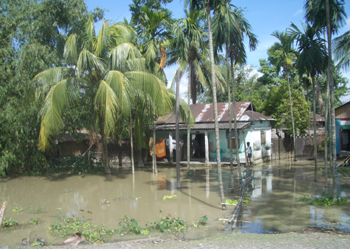
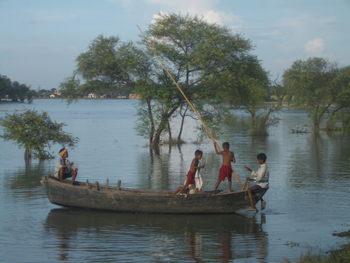
[Evidence of a devastating monsoon season. We saw hundreds and hundreds of displaced civilians who are now living along the road in temporary makeshift shacks.]
The team made the final push to Varinasi today. Despite witnessing even more devastating flood damage than in previous days, the road conditions improved. The team drove all day and encountered periodic bouts of heavy monsoon rains. As we get further into India, the obstacles on the roads increase, and the driving days get harder. (N.O.)
| Logbook for August 24th, Day 298 | ||
|
Start: Bhagalpur, India Time: 5:30 a.m. N: 25* 15.043 E: 86* 59.328 |
Finish: Varinasi, India Time: 11:15 p.m. N: 25* 19.587 E: 82* 59.343 |
Mileage: 300 |
August 25, 2004
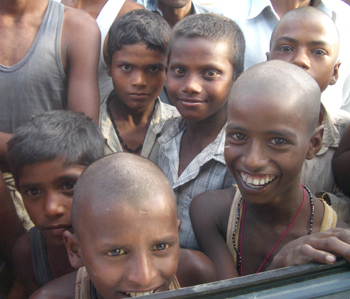
[Curious boys who live in shacks in a flood-damaged area near the Ganges.]
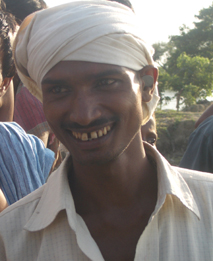
[A neighbor of the boys pictured above.]
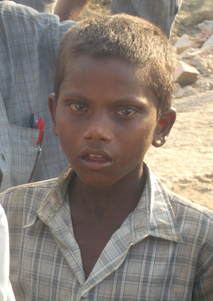
[Another boy whose home was flooded by the overflowing Ganges.]
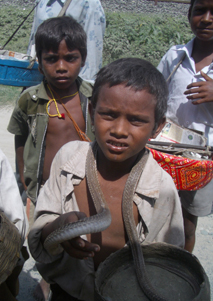
[This boy and his friends show motorists their cobras and then ask for money.]
25 August
After driving hard for the last couple of days, it was nice not to have to get up at the crack of dawn and get on the road. What was more important was to find an Internet cafˇ so we could catch up on some work and e-mail that we had been neglecting somewhat since we lost regular e-mail connection upon entering Myanmar.
The sun was hot, and the town was bustling as I first set foot outside the hotel. Clutching a bag of dirty laundry, I had something more important than e-mail to attend. As I passed from the safety of the hotel gates and onto the general streets, my attention was sought by about five different Indians trying to be as helpful as they could. They had answers for everything, and they always knew where you could get things cheaper (at their brother?s shop), or they knew of the perfect tour for you. They would walk down the street with you and just keep talking to you, figuring the longer they talked to you the more likely you would be to buy something from them or their brother.
Not trusting anyone, I feel like a fullback, plowing through the line and hoping to get to the goal line still on my feet. Getting away is not easy, as they are much better conditioned to dodge the steady stream of chaotic traffic that flows down almost any street in India. The rule is, if it moves, it will probably be on the road in India: cows, goats, rickshaws, motorcycles, scooters, bikes, bicycle rickshaws, people of all ages, dogs, chickens, buses, trucks, and the list goes on.
It is wild just walking by cows and bulls that are casually milling around in the road. With no ropes or anything, they are free to mill around in the rural or urban areas. They don?t seem to spook very easily. I have seen buses bearing down on them, only to see them hold their ground, turn their head, and dare the bus to hit them. What is crazy is, there is not just an occasional cow or bull, but there are a lot of them on the roads and alleys. Yesterday, while driving, I had to push a bull out of my way. I drove up to him, he looked back, and I idled forward and shoved him with my trusty bull guard front bumper. I have even patted them while slowing driving by; you have to see it to believe it!
India is a wild place; it seems to be so different than China. The reason I bring up China is the fact that China is the only other country that has more than one billion people. How do governments deal with such large numbers of people? China seems so ordered, and India so chaotic, but at the end of the day there seems to be some kind of order within the Chaos in India. Maybe the next couple of weeks will reveal some answers.
The rest of the day was spent working on computers and setting up our upcoming visit to Delhi. Meanwhile, I was looking forward to seeing the true heart of Varanasi, as we are scheduled to go on a boat ride down the sacred river Ganges. We will also see the funeral rites in this holy town of Vishnu. There is a lot in store for us here and much to learn.
--Todd
P.S. - We?re enjoying a much-needed rest day here in Varinasi. There hasn?t been a whole lot of action here, so far. The city is quite noisy and smelly, and Nancy and Chanda cannot go anywhere alone. It?s just too iffy for women to walk around without escort. The men probably aren?t even safe here at night...We promise to be careful and to stick together. Tomorrow, we will be filming a trip on the river to see the ghats where they burn bodies. (N.O.)
| Logbook for August 25th, Day 299 | ||
|
Start: Varinasi, India Time: N/A N: 25* 19.587 E: 82* 59.343 |
Finish: Varinasi, India Time: N/A N: 25* 19.587 E: 82* 59.343 |
Mileage: 000 |
August 26, 2004
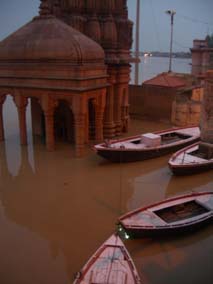
[Boats await the morning greetings of their boatmen, who paddle them up and down the ganges hauling goods and tourists along the Ganges River in Varinassi.]
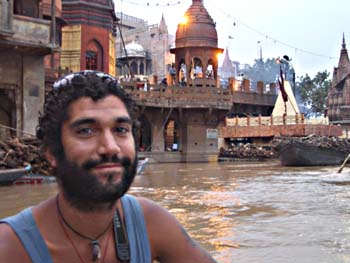
Neil smiles into the camera while bodies burn in the Ghat behind him on the banks of the Ganges River in Varinasi.
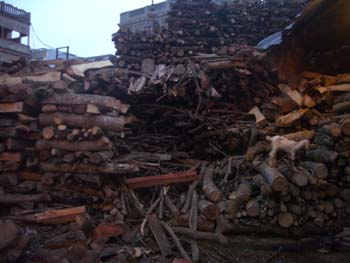
This pile of wood in Varinasi is used to burn bodies along the banks of the Ganges River.
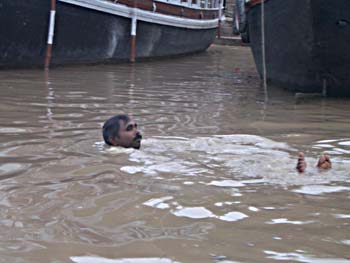
The water of the Ganges River in Varanasi is like poison to foreigners, but those who grew up with it can drink it, swim in it, and bathe in it with no ill effects. It is full of dead humans and animals and septic waste.
Our day began before the sun came up. The film crew had instructed us to meet in the lobby at 0445 to head down to the Ganges for some filming. We were met outside by our resident old taxi man who had stationed himself outside our hotel gates the moment we arrived in our four rich-looking Land Rovers. Each day he asked us if he could please take us somewhere in his auto rickshaw, and each day we refused: until today.
The relentless cabby and two of his fellow auto rickshaw owners smiled as the nine of us piled into the backseats of their three tiny taxis. We were headed to the banks of the Ganges (or Ganga) River to witness first-hand its role in the Hindu religion, and we wanted to be there for the rising of the sun. Unfortunately, the day was overcast, and it even shed a few tiny droplets on us as we stepped out of the rickshaws.
Because our participation in this ?mandatory fun? event was a film crew requirement, they were paying for it, and that meant we had to play witness to the serious business of Adam and his haggling routine. The filmies had arranged for us to meet a kindly guide fellow there (he had shown them around the previous day), and he was there to help with the haggling. Each boat pilot wanted 250 rupees or more to take us down the river and back. The Lonely Planet that Adam had read said a boat should not cost more than 50 rupees. The boat pilots argued that this was the rainy season, and that the flooded river made handling the boat extremely difficult, and perhaps even a little dangerous. It would take three or four boaties to take the nine of us down river and back. They could not budge on price.
So, Adam let them know he wasn?t going to be taken advantage of (anyway, he?d been to Varanasi before and had never paid such exorbitant fees), and he walked from boat guy to boat guy trying to find one who would listen to reason. Finally, after what seemed like 20 minutes or more, and after walking through the poopy, filthy streets of putrescence which are a hallmark of the city of Varanasi, we finally found a nice young boatie who agreed to take us for a price that was palatable to Adam (I forget what it was, but we all agreed to pitch in, and we were just happy to be getting into a doggone boat).
As we floated past the ?burning ghat?, we were warned not to take any pictures or film of it. See, this is where the Hindu people come to dip their deceased loved ones into the Ganges before setting them on fire amongst a pile of wood on the burning ghat to pass on to the next world. They believe that if you die in Varinassi, on the Ganges, your soul will be released from the never-ending cycle of reincarnation and death and go straight to Nirvana. That?s a big relief, because you never know who or what you might be reincarnated as after death. (As a side note, Hindus believe cows are sacred, and they believe that they are reincarnations of deceased aunts, uncles, cousins, grandparents, brothers, sisters, mothers, fathers, children, or other relatives. They do not eat beef. Cattle roam the streets and alleys like they own them, and nobody bothers them in the least.) Supposedly, way back in the day, one of the important goddesses accidentally dropped an earring into the water of the Ganges right there in Varanassi, and that is where they placed the burning ghat so many thousands of years ago. That?s why the Ganges here holds so much power.
People come down to the banks of the Ganges every day to bathe and swim, do their laundry, and drink in the brown water. Chanda once read a study in the Lonely Planet that showed that a sample of Ganges water contains somewhere around 1.5 MILLION fecal coliforms per milliliter of water, and the amount considered acceptable for human consumption is a mere 500, if that tells you anything. One sip of this water by a Westerner like you or me could kill us, sending us into a vomiting sickness that could incapacitate us and wipe us out entirely. But the people who grew up here have a colony of bacteria living in their bellies that protects them from the ill effects of the Ganges. They drink the stuff.
During our boat ride, we floated past a dead, bloated baby floating downstream. It almost didn?t look real, because of the bloating and decomposition that had occurred. That was our first dead baby. Not all dead Hindus are thrown into the Ganges; most are burned. But those who are pure, meaning those who are 14 years of age or younger, or mothers with innocent fetuses in their bellies, are dumped into the water without first being burned. The impure are burned to release their impurities, or something like that.
The boatmen floated us past several other ghats, where people were swimming, bathing, and washing clothes. I know it?s crude to mention it, but we also saw several men pooping along the river banks, and pile after pile of less-fresh poo were spied all along these poop-encrusted shores. Let me tell you, seeing a grown man pooping can change a person forever.
Eventually, the boatmen did an about face and strained against the oars to fight the flood current. We kept close to the banks, where the flow was at its lowest, and still we had to get out of the boat at a difficult section in order to get around a flooded temple. On the way back, we saw a floating object wrapped in white cloth, and I realized with horror that it?s head was exposed, both eyes staring right out me through a cloudy white film. A raven was sitting on it, pecking at its flesh. Thank goodness, it turns out this corpse, which we immediately thought was another baby, was actually a monkey. Whew! I don?t think I could have handled dead baby eyes. We also saw a dead and bloated cow, a dead baby caught in an eddy near some boats, and an unidentifiable corpse floating off in the distance with a big bird pecking away for his breakfast.
Not one of us will soon forget that boat ride.
After the boat ride, we walked over to the burning ghat because, for some reason, a few of the gang wanted to get a closer look. I warned everyone to hold their breath if they don?t want any dead people in their lungs. On the ghat were piles of burning wood and bodies, and below was a newer body, it?s skull, ribcage, and backbone clearly visible?and nothing else. The bodies burn down to ashes and a few small bones, and then they are sifted through by the ghat workers. Hindus are burned with their clothing and jewelry on, so the workers search for the jewelry, and anything that is found is given to the foreman, who then sells it to tourists. Families who carry their loved ones there to be burned help or watch as the body is dipped one last time in the Ganges and then set afire. They stay to watch it burn, and then, once there is nothing left but ash, they break a clay urn filled with ganges water over the ashes and depart. Mission accomplished.
While we were there, we could see all sorts of identifiable bone pieces, and we were told that the hip bones and the chest are the slowest to burn. This will gross out many of my readers, so take caution. You may want to bail out now: There was a yellow dog at the ghat who was sifting through the bones. I watched him closely, and eventually he found a piece of bone that still had some charred flesh remaining. He laid down with his prize and gnawed away at what looked like a foot, or something. Eventually, a worker chased him off. As we exited the ghat, I saw that same dog in the sidewalk, finishing up his bone. He walked off, and a man took a tin cup of water and washed the remaining crumbs of flesh and bone into the drainage ditch. All in a day?s work.
Later, we learned that old people with no families come here to await death, and we visited some old women living near the burning ghat. Good Hindus visit them on occasion to feed them, take care of them, give them money, and provide them with companionship. They get good kharma for that, so maybe it?ll help them in their next life. We gave the ladies we visited some money and flashlights, and they seemed pleased.
As we tiptoed gingerly through the cow dung, human feces, rotting vegetables, and rubbish heaps, we reflected on the sights and experiences of the day. India has more than a billion people, and we have seen a good number of them. In areas like this, the plague still exists, and people suffer from and even die from afflictions that would hardly faze first-world nations. Yet, feed a drop of Ganges water to an American, and you would soon hear the sound of death or debilitation knocking at the door. Go figure.
P.S. - Friends, family, followers...We're in Varanasi, India, on the poop-encrusted banks of the Ganges River. Today we saw dead bodies burning and floating. Cow, goat, and human feces litters the streets and river banks. This town is crazy. The people are nice. We have a lot of updating to do on these journals, and I apologize for the delay. Will post more very soon. Everybody is doing very well. Nobody is sick, yet.(N.O.)
| Logbook for August 26th, Day 300 | ||
|
Start: Varanasi, India Time: N/A N: E: |
Finish: Varanasi, India Time: N/A N: E: |
Mileage: 295 |
August 27, 2004
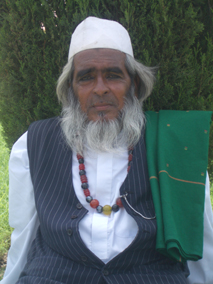
[A very dignified man poses for a photo in the yard of the Taj Mahal.]
So, here I am in India. We left Varanasi at 5 a.m., and I am currently in the back seat of our vehicle en route to Agra, home of the Taj Mahal, the greatest monument to love ever built. It?s raining on and off, and we have somewhere between five and ten more hours of driving ahead of us.
I think India is the one country where it is better to drive in the rain, basically because all the Indians, cows, goats, and assorted riffraff stay inside instead of cluttering the roads and making life miserable for those driving it. In fact, I think rain actually doubles the speed at which you can travel from an average of 20 m.p.h to 40.
Yesterday was an interesting day; we got up at four, which in India has become the norm for us, and headed out on a shoot with the team. We headed down to the Ganges and rented a boat for a sunrise cruise. There we saw all the expected things one might see on the Ganges: bloated floating dead bodies of people and animals, assorted carrion-eating birds, people bathing and brushing their teeth in that same water, and probably about three hundred people pooping on the river banks, which for some reason we all found hilarious. After that, we took the team to the burning ghat to see and learn about the cremations, which they hadn?t experienced the day before.
Once the shoot was over, I took off and did some shopping. I eventually ended up in a silk store, where Neil, Adam, and I had a blast with the guys that worked there. I ended up with a bag full of purchases, including a disguise for Kashmir (see top photo), and a cool custom made gift for my moms. I hope she likes it because it was rather expensive.
By the time I was done with all that I was extremely tired, I crawled into my musty bed (all beds in India are musty) and curled up with my current tome of choice East of Eden, by Steinbeck, which by the way, I am heartily enjoying. By nine I was asleep, only to once again be woken up at the crack of dawn by that all-too-familiar-by-now hotel desk wake up call.
P.S. - We arrived in Agra, home of the Taj Mahal, this evening. Tomorrow, I (Nancy) will update this webpage, and the others will visit the Taj Mahal. We all will have a photo shoot there at sunrise or sunset. The drive here was quite difficult, because driving in India is indescribably hectic. Sooo many obstacles on the roads. Potholes, people, bicycles, sacred cows, goats, kids, people pooping, trucks coming right at us in our lane...So our average speed is really low. We just can't travel very far each day, even when we get up to leave at sunup. Everybody is doing well. Adam is our first bad-water casualty (don't worry, Georgina, he's alright!), and we're sure to have more. We'll keep you informed. Photos and journals are coming soon. Apologies, but Internetting is quite difficult here. (N.O.)
| Logbook for August 27th, Day 301 | ||
|
Start: Varinasi, India Time: N: E: |
Finish: Agra, India Time: N: E: |
Mileage: ??? |
August 28, 2004
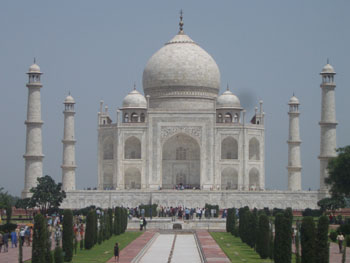
[Above, the most popular photo of the Taj. Below, the real photo experience of the Taj. For whatever reason, Indians LOVE photos of complete strangers (Western strangers, that is.).]
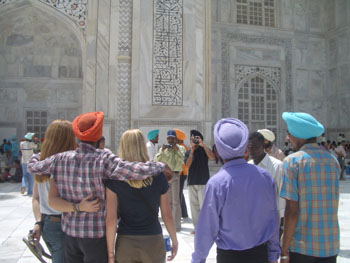
Adam is feeling better. Much of the team visited the Taj Mahal today, and others tried in vain to do some Internetting. Agra is nicer than Varinasi, though it is still pretty grim. Nothing is new here. Nothing. The weather is super-hot and oppressive. We leave tomorrow for Delhi, which is a much bigger and richer city. (N.O.)
| Logbook for August 28th, Day 302 | ||
|
Start: Varinasi, India Time: N/A N: E: |
Finish: Agra, India Time: N/A N: E: |
Mileage: ??? |
August 29, 2004
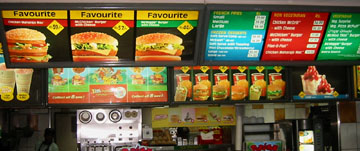
[On the way to Delhi, we stopped at our first Indian McDonald's. Can't say we enjoyed it too much. Everything was spicy and, well, just weird. No beef eating in this country, so they have a Maharaja Mac instead of a Big Mac. I think it's chicken...or mutton...]
Well, here we are on Sunday again. I end up going to the Taj Majal again with Chanda and Nancy, because, what the heck? They really stick it to the foreign folks
for $17 dollars a person. I figure this is once-in-a-lifetime stuff so I am trying to ignore costs as much as possible. Turns out this is terribly easy here in India, with the value of the Rupee to the Dollar. I quickly pack around noon time and grab yet another Pizza Hut pizza (such a wonderful thing to find some normal food), and we are off to do some sort of photo shoot before we leave Agra for Delhi. We end up along the River with the Taj Majal in the background and, lucky us, the D1 starts running rough. Turns out one of
the plug wires is failing and we need to fix it. We find a nice bit of shade off the side of the road, and of course the entire world is there to watch. At this point, the Agra journalist that was doing the photo shoot needs to leave, but before he does, he warns us to be careful because this is not a safe area. I have been put on guard-the-tools duty, and let me tell you we needed someone watching over things. There were a half dozen kids poking and prodding at everything. At one point I catch one of them with his hand inside the car. The very same little kid I catch climbing on top of D1. He just will not go away. I am watching him very closely, and while Nick is somewhat distracted making Iridium phone calls this little fella has his eyes staring directly at his pockets. It seems clear
that these kids are up to no good, especially this one little fella. One of the other kids motions towards one of the other children and says "pick pocket"; now I know there is concern. Nick is now starting to get fed up with these little brats and keeps trying to get
the kids to go away. Nothing seems to work, and he finally grabs a can of WD-40 and sprays it towards them. Not AT them, but in their general direction. This seems to work for the most part. I now stand guard with the WD-40 can, and it seems to keep them at bay, at least 10 feet away or so. Looks like we managed not to loose anything, at least this time.
P.S. - We were planning on leaving between noon and one, but a fouled cyllinder on D1 prevented that. The problem is most likely a result of bad gas. We fiddled with it for several hours and eventually had to arrange a tow to the Land Rover service center in Delhi. The vehicles require a flat-bed truck for transport, and Justin searched until he found one. It was a bit of a tight fit, so we removed the Santa Cruz mountain bike, and we held our breath. Nick had to climb out through the driver's window, because it was too narrow to open the doors. We lashed everything down and rigged it so the vehicle wouldn't hit the side walls on the bumpy roads, and then we left. We hit a McDonald's along the way (It was already dark and well-past dinner time by now.). They just don't do Micky D's the here the same as they do it in the U.S. The Chicken McGrill was too spicy for wimpy nancy to eat. The truck was slow, and it took a while to find a loading ramp for the off-load, so the recovery crew was up all night. Everybody's at the YMCA now and working hard on various tasks. Today was a long day. Oh, and we even did a photo shoot for a local newspaper. (N.O.)
| Logbook for August 29th, Day 303 | ||
|
Start: Agra, India Time: N/A N: E: |
Finish: Delhi, India Time: N/A N: E: |
Mileage: ??? |
August 30, 2004
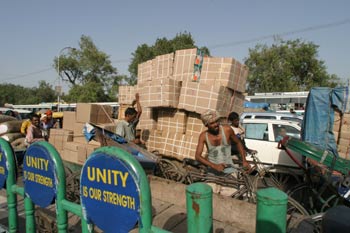
[Unity is our strength... They all struggle down the crowded streets together, as one...]
Wow, I must say, arriving in New Dehli is like nowhere else in India we have seen before. There are traffic lights, nice vehicles on the road, Mc Donald's, TGI Fridays, Ruby Tuesdays, shopping malls, upscale hotels, and fewer cows and less mayhem in the roads. In fact, we arrived at 3:30 a.m., so there weren't any vehicles on the road. It is like stepping back into America, well.... sort of. There are still tons of Indian people running around and constantly trying to sell me something or beg for money or food, and you still have to watch your step for cow dung. It also really depends on where you decide to go. You can go to Cannought Place, which is a big circle in New Dehli that has all kinds of pubs and nice restaurants to eat at, or you can go to Old Dehli and many of the various markets and step into small alleyways filled to the brim with people selling silks, saris, antiques, jewelery, pipes, and whatever your heart desires. Old Dehli takes you right back into the heart of the Indian lifestyle that resembles the rest of India we have visited so far. The streets are filled with so much traffic, people, and rickshaws, that it just all stands still together......I guess that is what they mean by unity here in India?
We are staying at the YMCA, and it is an alright place. Your breakfast and dinner are included in the price you pay for staying there, which is pretty steep, and they still charge you 100 rupees to use the gym or pool. Every morning you can hear whistles blowing and people doing their exercises with their swim caps in the pool. It is just a few blocks away from Cannought Place.
The rickshaw drivers here are pretty good at trying to rip you off. The trick is to get in without negotiating a price, and when the ride is over, just give them what you think is fair, and then walk away and don't look back. It has worked every time for us, although the ladies have more trouble with it than we do.
Today, I spent most of the day lying on the cement floor of the Land Rover dealer about 45 minutes outside of Dehli. Justin, Adam, and I were waiting around all day for an itemized list of all the work that needs to be done on the vehicles. The problem is that one of our vehicles is at another site, and that is where the information was being delivered from, yet their fax and email wasn't working. So they eventually called and we sorted it out. I was feeling terrible, had a minor fever and the runs, so lying on the floor was the best remedy. India has had its fair share of sending me to the bathroom. I always knew coming here would give me the runs, and it sure has. I haven't had anything real serious, just super hot burning fire liquid streamline poops every now and then!!!
So now that we are in Dehli, we have some time to chill here and get a lot of work done. I have to edit tons of photos and catch up on all kinds of emails. We are getting our visas sorted out and taking care of the vehicles as well. Justin is running around getting the press lined up, too, so we have our work cut out for us. I will go and explore Dehli in the coming days. Until then, enjoy yourselves and next time you go pinch a loaf, smile for me and appreciate how good and solid you have it.
Neil
P.S. - Because some of the team stayed up all night with vehicles last night, today was a recovery day. We did manage to do some work and a little sightseeing, so that's good. Delhi is a nice city, and it's good to be away from the squalor. The problem is that this YMCA doesn't have A/C. I mean, who builds a hotel in the hottest place on Earth and doesn't install A/C? :) Laaaater. (N.O.)
| Logbook for August 30th, Day 304 | ||
|
Start: Delhi, India Time: N/A N: E: |
Finish: Delhi, India Time: N/A N: E: |
Mileage: 000 |
August 31, 2004
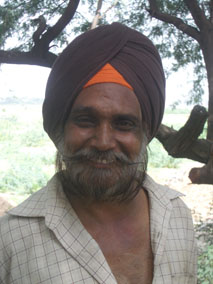
[Nancy spoke to this nice Seik Muslim near the Taj Mahal. He owns a radiator repair shop. People of his religion can be seen throughout the streets of Delhi, too. Their religion varies greatly from the Hindu religion of many of the other Indians here.]
Still chillin' in Delhi. Actually, there's nothing "chill" about it. It's blazing hot here, and we don't have A/C in our rooms. We sweat in our sleep. Yuck. While here, we work, sweat, sightsee, sweat, and sleep. But life is good. (N.O.)
| Logbook for August 31st, Day 305 | ||
|
Start: Delhi, India Time: N/A N: E: |
Finish: Delhi, India Time: N/A N: E: |
Mileage: 000 |
September 01, 2004
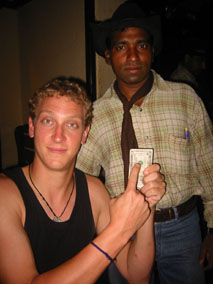
[Justin poses with an Indian cowboy at "Rodeo" restaurant in Delhi, where the team celebrated Chanda's birthday.]
Delhi is certainly a bustling city. Actually, I am quite impressed with how spread out it is. I have continued to work on visa acquisitions, so much of my time has been spent going to and from embassy row here in Delhi. Embassy row is beautiful! Large, expansive compounds with manicured lawns, flowers and trees. It is not easy to walk from one embassy to the next, as they are so big. It is a pleasant switch from the horns, crowds, and hawkers of Connaught Place.
Although Embassy row is nice, it will be much nicer to finish our business there. Completion of this business will mean that we can freely finish the Asian leg of our journey. All of these visas make me long for the Americas, where visas were never required. All we had to do was show up at a border, and they would stamp us in and out with out any problem.
In Asia, we find ourselves paying hundreds of dollars, per person, to be admitted to countries. What makes matters difficult is that some of these countries require exact dates of arrival and departure. This isn?t so difficult if you are arriving by plane, but when you are trying to project where you are going to be in two months on a vehicle expedition, things are a lot tougher (floods, vehicle problems, Maoist rebels, etc). We are managing, but the logistics become quite complicated. We seek all the flexibility we can but are forced to work within the system when necessary.
Only a few more visas to go, and I will hang up my visa hat, and none too soon.
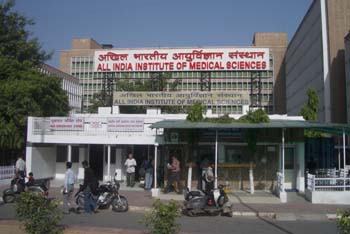
After doing visa detail, I switched back to working on Parkinson?s Disease awareness. I met with Dr. Maduri Behari today. She is the Head Neurologist at All India Institute of Medicine (AIIMS). I was able to get in touch with her by a contact given to me by our friend, and champion, Mr. Sabharwal.
Ever since we left Bangkok, I had been chasing down Parkinson?s leads in India. I found several organizations, but they had all been in the South of India. I have e-mailed and phoned organizations and doctors all over India, but because of bad or unused e-mail addresses, changed phone numbers, or other limiting complications, I was never able to talk to anyone within the Parkinson?s disease community, that is until now.
Dr. Behari was great; we had a fantastic meeting. She told me of how she decided to become a neurologist, and she discussed the local Parkinson?s organization PRAN (Parkinsonisms and Related Disorders Awareness Network) here (and lamented the fact information about it was not yet available on the net). She told me why so many people wanted to cover it up, and she invited me to her weekly clinic on Saturday. It was great that she took the time to meet with me. You can read more about the interview soon on the Parkinson?s page.
The evening ended with a team meeting to discuss the upcoming schedule, expedition updates, and what needs to be done between now and when we leave Asia.
After the meeting, the team finally got around to celebrating Chanda?s ?29th? birthday at a place called Rodeo. The team ate Indian tacos and burritos (no beef available) served by Indians wearing cowboy gear. It was surreal, but a perfect way to celebrate. Now we have celebrated every single team member?s birthday while on the road. If we don?t hurry up and get home, Neil will get a double doozie.
P.S. - We've been celebrating Chanda's birthday for several days now. (Her real birthday is the 27th of August.) Tonight, we went to a Tex-Mex place (the only one in India, I think) called Rodeo. There, you can eat yummy tacos served by Indians in Cowboy outfits. Cowboys and indians? I think not. Just cowboys...or Indians impersonating cowboys. Life is good...and Chanda is 29...again... (N.O.)
| Logbook for September 1st, Day 306 | ||
|
Start: Delhi, India Time: N/A N: E: |
Finish: Delhi, India Time: N/A N: E: |
Mileage: 000 |
September 02, 2004
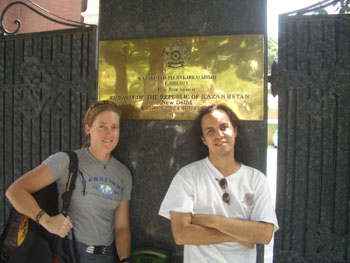
[Much of Todd?s time is spent visiting embassies and attempting to get visas for the team. Here, Nancy and Take Me With You! guest, Matt Candelaria, wait to pick up their passports from the Kazakhstan embassy in Delhi.]
Journal by Nancy
Uh, like, we?re in Delhi, and stuff. Delhi is, well, pretty much indescribable. What I mean is, I can describe it, but you still won?t get it. I guess I?ll just try my best.
To begin with, Delhi is hot. I mean, Delhi is Africa hot, and I am hereby changing the descriptive term ?Africa hot? to ?India hot.? I?ve never been to Africa, you see, and I know for a fact just how oppressively hot India is. So, India is the new hottest of hot spots. While in India, we have to dress fairly conservatively so as not to draw too much attention. T-shirts are ok, but long, loose pants are a necessity. We sweat a lot, and that means we drink lots of water. The plus side is that hot weather decreases the ol? appetite.
Delhi is crowded. All of India, with more than a billion people, is very crowded. All of these crowds migrate to the streets together, so driving here is more difficult than anywhere else I?ve ever been in my entire life. Even in the rural areas, people flock to the streets in droves and avoid moving over to the shoulders at all costs to avoid stepping into dirt or grass. It seems they?d almost rather get hit by a car or truck than move over into the dirt. They march their livestock down the middle of the road, they ride bicycles and mopeds, drive tuk-tuks (they?re called auto rickshaws here), maneuver pedicabs, walk side-by-side, sit, nap, play cards, dry their corn, park, poop, pee, stand, and even roll (we saw a ?holy roller? all stretched out and rolling steam-roller style down the street once) down/in the middle of the road.
In the city here in Delhi, traffic is a mess. It?s like full-on, no-holds-barred bumper cars. By now, most of the team has been involved in some form of auto rickshaw accident. Matt and I were in a rickshaw that barreled into the back of another because his brakes went out. We had to hop into a new rickshaw. Colin?s cab ran over a pedicab and then hit a little boy. The boy was ok, and Colin ended up paying some rupees for the pedicab?s bent wheel, but relatives of the boy beat up the cab driver. We?ve all witnessed accidents, but luckily nobody has been injured. Auto rickshaws are the best form of transportation, because they can maneuver through tight spaces, and in Delhi, there?s nothing but tight spaces. The rickshaws zip down back alleyways, around buses, through crowds, onto sidewalks, through red lights, and past traffic jams while the passengers hold on for dear life. Diesel fumes are choking, so a lot of breath holding goes on in Delhi.
Delhi is smelly. I?m not being rude; I?m just stating the facts. There isn?t a lot of progress, so far, in the sanitation department in India, so garbage, and sewage, is often seen and smelled in the streets. (Again, with the highest population in the world, sanitation is a foreseeable problem.) I once saw a cow with its head in a dumpster, and it was chewing on a plastic bag the way a country cow might chew on hay. Poor thing. Cows are holy here, and they have free rein to wander the streets pooping on and eating everything in sight. In Varinassi, I saw a big cow poop on a baby cow. Delhi actually has far fewer livestock/poop/garbage in its streets than Varinasi did. There were cows and poops at every turn in Varinassi, but Delhi is relatively cattle-free, at least in the most crowded areas. Regardless, Delhi has a garbage problem. I bought an ice cream once, and I asked a local where I cold deposit my wrapper. He pointed to the ground and insisted that I put it there. I refused. He thought I was nuts. He looked offended. For whatever reason, even when I am surrounded by mounds of garbage, I still cannot bring myself to litter. I once put a plastic water bottle on a pile of garbage in Varinassi, and I still feel bad about it. Sweepers come through and pick up the piles, but it just ain?t right.
Delhi is friendly. People here are genuinely friendly, and I feel relatively safe in the city. I won?t walk around alone at night, but that?s just common sense, no matter what city I?m in. Men will jeer and stare and make lewd and offensive comments, but not any more so than in many American cities. We just need to steer conversations far away from marital status, etc. For the purposes of my stay here, I have a boyfriend/husband/fiancˇ, depending on the situation. People everywhere are kind, as long as the subject of politics is avoided at all costs. When we leave Delhi, it is the people whom I will miss the most. They?re wonderful.
Delhi is a fine place to visit, and the shopping is good, but it?s not somewhere people like us want to stay for more than a couple of weeks. Being here for two weeks (plus) is too hard on this restless crew. As much as we have enjoyed our stay, it will be nice to get moving again! You can?t tie down a band of vagabonds?
P.S. - Just working and sightseeing here. Trying to keep from sweating to death. Getting all our visas for the final leg of our journey. We want to come home and reunite with all of you wonderful people! (N.O.)
| Logbook for September 02, Day 307 | ||
|
Start: Delhi, India Time: N/A N: E: |
Finish: Delhi, India Time: N/A N: E: |
Mileage: 000 |
September 03, 2004
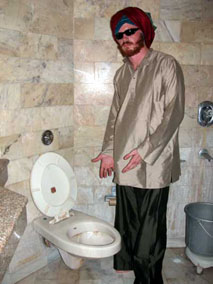
[Colin has gone native here in India.]
Well folks, I?m not really one for museums. Most works of art in art museums don?t hold my attention as long as other peoples?, not that I don?t find them interesting. I read really fast, so at the displays in history museums, I breeze though entirely too fast. When I travel, I very rarely visit museums, unless they?re extremely special, and here in Delhi I found one of those museums: The Museum of Toilets.
Yes, I know it?s hard to believe, but in one of the most unsanitary metropolises on this planet there is a museum dedicated strictly to the porcelain throne. It cracked me up. I mean, I think only 30 percent of Indian families even have toilets.
The museum was started by a man who has made it his life?s task to bring sanitation to the Indian Nation (giggle). He has built toilets all over the country, including the worlds? largest toilet compound, somewhere in southwest India. One of his main goals is the abolishment of what is known in India as ?manual scavenging.? Manual scavenging is practice that pretty much all of us westerners would find disgusting. You see, in India, a lot of people have what are known as dry latrines, which are basically just a bucket that you poop in. Anyway, these scavengers, who are members of the absolute lowest caste of untouchables, come along, pick up your ablutions every night, and then dump it out in a field somewhere. It?s an entirely unhealthy and unsanitary practice, not only for the scavengers themselves, but for all people, because the feces ends up in people?s water systems. You can see why they are trying to abolish the practice, and untouchability in general.
The museum itself contains donations of various toilets and bathroom objects from more than twenty countries. They had some extremely interesting stuff there. For instance, they had a replica of a French king?s throne that actually was a toilet, complete with ashtray and cup holder. One of the more amazing items in their collection was an American-invented toilet that, rather than using water, electrically zapped your excrement into ash. Unfortunately, they wouldn?t let me use it. I was also a little disappointed when I used their bathroom and it was just a normal toilet. You?d expect more at a museum dedicated to the thing. They had some great handouts, and of course, a guest book. I was shocked when I read through it that nobody had made any jokes or puns at all. Most of the comments, and there were a lot, were extremely lame. Things like ?Very interesting? or ?Wow, I never knew there was a museum dedicated to toilets.? So, Adam and I took it upon ourselves to spice that book up. So I wrote something along the lines of ?Great museum, by far the crappiest place I have ever been in my life.? I forget what Adam wrote, but I?m sure it was funny too.
Anyway, there isn?t much to do in Delhi itself outside of shopping, so if you are there, you absolutely must visit the museum of toilets.
P.S. - Today, Take Me With You! guest Matt Candelaria decided to fly to Nepal for the weekend. Chanda and Nick surprised Nancy with assistance so that she could join him. They are incredible, and, realizing that was the one place that is most important to her, they made it possible. She loves them for that, among other things. (N.O.)
| Logbook for September 03, Day 308 | ||
|
Start: Delhi, India Time: N/A N: E: |
Finish: Delhi, India Time: N/A N: E: |
Mileage: 000 |
September 04, 2004
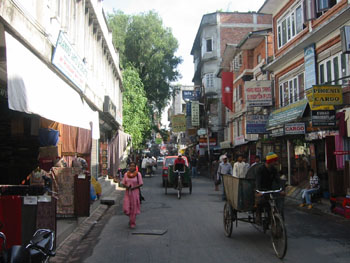
[A Kathmandu street. Typical of the last several countries we have visited, Nepal's streets are crowded with tuk-tuks, pedicabs, and hawkers trying to sell anything and everything they can to tourists.]
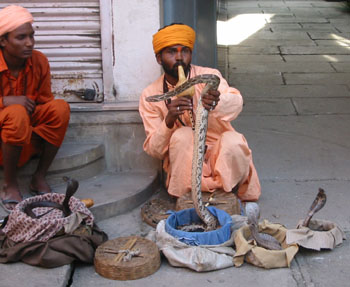
Here, Nepalese men charm snakes with their seductive music.
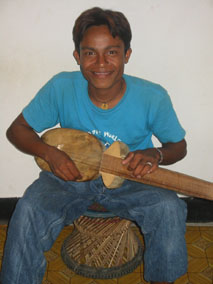
This musician sang and played music with his friends during the curfew, at Nancy's request. It was a great way to stave off boredom and learn some Nepalese culture.
During the first five minutes of our walk through Kathmandu, Matt and I found a whimpering, crying, screaming dog curled up in a gutter. Not knowing what to do, we took him to the animal hospital, where he was diagnosed with canine distemper. We had to have him put to sleep. I bawled my eyes out as I held him while the doctor administered the painless death drug. Later, we enjoyed Kathmandu, and I heard some traditional folk singing and music. Back in Delhi, the team worked and played. Everybody is well. (N.O.)
| Logbook for September 4th, Day 309 | ||
|
Start: Delhi, India Time: N/A N: E: |
Finish: Delhi, India Time: N/A N: E: |
Mileage: 000 |
September 05, 2004
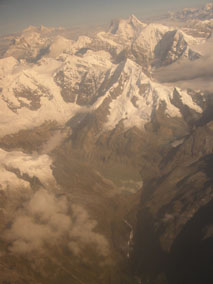
A view of the Himalayas from the air.
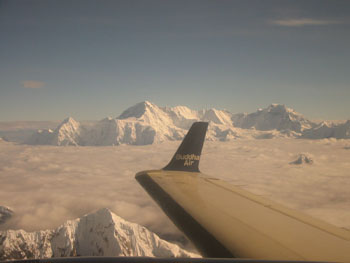
A view of the Himalayas and the wingtip of our Budda Air aircraft.
Journal by Matt Candelaria
Just got home from a weekend in Nepal. Unfortunately, the LONGITUDE Expedition decided against driving through Nepal, so I decided to fly there and take the "Mountain Flight" to see the mighty mountain. Nancy joined me on this weekend get away. When we arrived in Kathmandu, I quickly understood why it is not good to drive though Nepal. There was a curfew imposed, and on the cab ride of five kilometers to the hotel, there were around 8-10 stops from the military that was stationed at pretty much every major street corner in the city. We were the only people besides the military and a couple other cabs coming from the airport. I was anything but comfortable.
The next day, we there were no Mountain Flights, so we hung out in Kathmandu. There was a curfew at 2 p.m., so we had to do our shopping early. The town did open up from 5-7 p.m. for dinner, so at least we were not completely trapped in the hotel. The next morning we finally got the Mountain flight.
Mt. Everest is really amazing. I looked in the cockpit, and we were at about 26,000 ft, and the mountain was still above us. Really amazing. We were flying on Budda Air, and at first I thought they were doing a really great job. They let everyone in the plane (16 of us) go up to the cockpit one by one, and the copilot showed us Mt Everest. It seemed
really cool. I didn't take many pictures, because I figured I would do that out the side window when we finally got there. Turns out, we should have been snapping away, because we were probably 10 miles from Everest when the plane turned around and headed back to Kathmandu. I was really disappointed, but at least I got to see the mountain.
We had to leave for the airport early that day because of curfew again, so we spent the day waiting around Kathmandu Airport. We met a couple of nice ladies from Australia and Israel, which really helped pass the time. We had spent so much time talking with them that it was sad to say goodbye.
Strangely, when I finally got back to familiar old Delhi, I felt at home for a moment. I guess I just felt safer because of the way things were in Nepal. I didn't like being in a potential revolution.
Matt
P.S. - Matt and Nancy took a mountian flight to see Everest and the Himalayan range. It was disappointing, as the plane didn't get at all close to the mountain. But it did reinforce Nancy's determination to return and climb that beast of a mountian. The rest of the team is in Delhi enjoying themselves. (N.O.)
| Logbook for September 5th, Day 310 | ||
|
Start: Delhi, India Time: N/A N: E: |
Finish: Delhi, India Time: N/A N: E: |
Mileage: 000 |
September 06, 2004
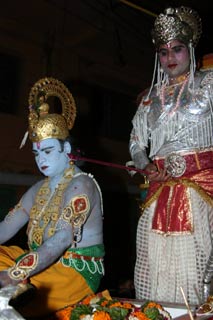
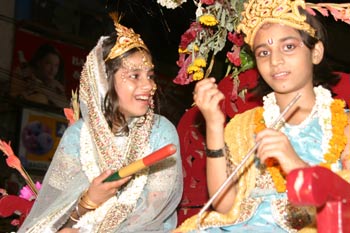
[The blue deity, Vishnu, rides past on a float in the Krishna parade in New Delhi.]
We moved hotels into another part of not-so-New Delhi, and there are all kinds of hotels and shops here. It is filled with people and noises all the time, especially when the speakers across the street are blaring music and advertising. I must admit, I do love the music they play, but all the ads and prayers in between are a bit annoying when it is so loud! The music is fascinating, and the voices are so melodic and sweet that you become entranced by it all. This is India, and there is music blaring everywhere. I had been hoping to hear this the whole time I had thought about coming to India. In Varanasi, we found some live musicians playing tablas and sitar, and that is what I had hoped to find. Here in Delhi, though, it is more difficult to find.
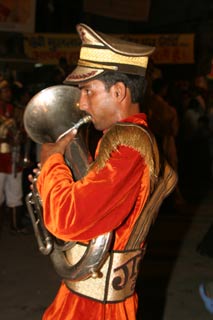
This evening, we had a pleasant surprise though. There was a parade filled with marching bands and floats and hundreds and hundreds of kids and adults screaming and singing. The Krishna festival, which has been going on for throughout the month of August, is supposed to have its finale on Tuesday; however, last night they had a parade. It was great, and it was passing right in front of our hotel. The parade came in waves, too. It would start with some police clearing the way, then the marching band with drums, trombones, trumpets, baritones, and whistles would march down the street with lights carried above them, which were electrified by a wheeled generator that a few people would push behind. Next the floats would start with different statues of Vishnu and all kinds of deities represented. The women, men, and children were all dressed up in very fancy outfits and painted faces. It was extremely colorful and predominantly orange, since that is the color for Krishna. Eventually it would die down, and then the street would be somewhat darker and quieter, but then five minutes later another procession would come around. This happened about five times and lasted for a little more than an hour.
Kids were running around smiling and slapping five with me, and whenever I would try to take a picture of anything, five to ten kids would jump in front of my camera and make it next to impossible to take a shot. It was pretty funny. They were really aggressive, and some of the shop owners would come out and yell at them and shoe them away. Unfortunately, Justin had his wallet stolen from his pocket while he was shooting. The kids are very sly, very courageous, and very annoying. It really is too bad, because they are so cute, too.
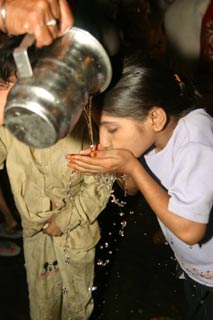
Amidst all the action from the parade, the people and the children watching would stop by a man standing on a bench who was pouring out water from a pitcher, hold their hands out and get a drink. Everyone was thirsty and sweaty and panting heavily. It was quite a scene. No matter where you go in India, there is always something interesting to stumble upon. The Krishna festival is just one of the many.
Neil
P.S. - Matt and Nancy are back in Delhi and happy to be with the rest of the team. Team is still working on Kazakhstan and Russia visas. We're at least in a hotel with A/C now. Whew. (N.O.)
| Logbook for September 6th, Day 311 | ||
|
Start: Delhi, India Time: N/A N: E: |
Finish: Delhi, India Time: N/A N: E: |
Mileage: 000 |
September 07, 2004
Journal by Nancy
Todd visited this hospital in Delhi, and he also spoke with a Parkinson's specialist. Todd's words: "Dr. Behari was great; we had a fantastic meeting. She told me of how she decided to become a neurologist, and she discussed the local Parkinson?s organization PRAN (Parkinsonisms and Related Disorders Awareness Network) here (and lamented the fact information about it was not yet available on the net). She told me why so many people wanted to cover it up, and she invited me to her weekly clinic on Saturday. It was great that she took the time to meet with me. You can read more about the interview soon on the Parkinson?s page.
P.S. - Just Delhi. There's a huge Krishna celebration going on here, and it was a loud and restless night. People are dancing, singing, and playing music in the streets. All night. (N.O.)
| Logbook for September 7th, Day 312 | ||
|
Start: Delhi, India Time: N/A N: E: |
Finish: Delhi, India Time: N/A N: E: |
Mileage: 000 |
September 08, 2004
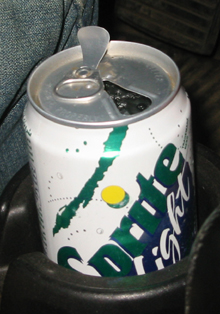
[Remember these? Anyone born after about 1980 won't, but you oldies will. Pull-tabs. They still have these on the soda cans in India. Seen 'em on the fake Red Bulls, Coke, and Sprite...For you youngsters, the reason they are discontinued is because the standard operating procedure was to pull off the tab and stick it inside the can. I guess a few challenged individuals ended up choking on them or severely injuring their innards. But we here at Drive Around the World still like to put the tabs inside our cans...we like risk...and danger...]
Still in Delhi. Still doing visa/permit work. Still hot. Still crowded. Still seeing sacred cows everywhere. Still lots of cute dogs in need of good homes. Even saw a nice yellow labrador retriever puppy yesterday that Nancy almost kept... (N.O.)
| Logbook for September 8th, Day 313 | ||
|
Start: Delhi, India Time: N/A N: E: |
Finish: Delhi, India Time: N/A N: E: |
Mileage: 000 |
September 09, 2004
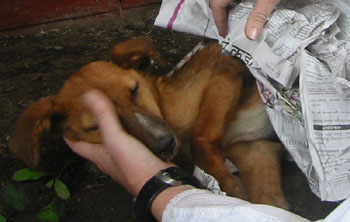
[Nancy's latest stray closes his eyes against the pain as he is picked up to be carried into a Nepalese veterinary clinic.]
Delhi, Delhi, Delhi?We at Drive Around the World know we?ve been in one spot too long when our weekly journal day rolls around more than once. This happened in Bangkok quite often, and, frankly, it?s no picnic trying to come up with interesting things to write about when we?re not actually driving.
I described my impressions of Delhi in my September 2 journal, so I won?t bore you with that again. We?ve been venturing out into the hot and sticky weather here each day, taking auto rickshaws to various markets for shopping and errand running, and we usually get charged exorbitant fees. Delhi has turned me into a very rude bargainer, and of that I am not proud. On more than one occasion, I have told the driver off for charging Chanda and me triple or quadruple what he would charge a local, and on another occasion I just handed him twenty rupees and walked away as he screamed about the other eighty rupees he wanted. The nerve!
Occasionally, I have the good fortune to meet a sweet little street dog who lifts my spirits and allows me a brief escape from the hustle and bustle going on about me. The dogs here in India are bigger, healthier, prettier, and more pure-bred-looking than those of many other countries. We refer to them lovingly as ?third-world dogs?, and we love them. Two days ago, for example, I met a yellow Labrador retriever puppy. He was beautiful, and he was wandering the streets alone, so I decided to befriend him. When I first spotted him, he was being scolded and chased off by a mean-looking chef holding a butcher knife! Yikes! So, I scolded the chef and led the dog to a safer loitering area. He was so cute and friendly that I ALMOST kept him. The reason I didn?t? A fear of commitment. Dogs like that one are at least a 10-14-year commitment, and I can?t make that step. That?s definitely a good thing, too, as it has prevented me from taking on strays in nearly every country we?ve visited.
A few days ago, as you might already know, Matt Candelaria and I took a short weekend trip to Kathmandu in Nepal. The trip was too short, but it was great. By the way, I have Nick and Chanda to thank for making my dream of visiting that city a reality, so, ?Thanks, Nick and Chanda!? Matt?s journal (Sept. 5) explains the curfews, Maoist insurgents, the city, and the mountain flight, so that saves me from including a description here. What he didn?t tell you about is the dog we met on our first day out in the city.
We were walking down the street, taking in the sights; Matt was eyeballing cool clothing for his girlfriend, and I was drooling over all the camping and climbing stores, when we heard the most woeful cries up ahead.
In the gutter in front of one of the shops was a cute little dog curled up into a little ball, his head down, rear end immobile, and front paw lifting up and down rhythmically. Careful not to receive a bite from the obviously scared and hurting pup, I tried to comfort him and feel for broken bones. I was certain he must have been hit by a car and had his hips busted or dislocated. But everything seemed intact. I didn?t know what to do. He was cute, scared, and helpless. Matt and I could not stand to see him suffering, yet we couldn?t walk away and pull the out of sight-out of mind trick. Matt stood by the little fella while I ran into a bookstore to get a map and directions to the nearest veterinary clinic.
Because he was covered in mud and cold, I wrapped him in a newspaper and held him to my chest. We hopped in a taxi and rode some 10 minutes to a vet; it felt like a half hour. The pup screamed at every bump. When we arrived at the clinic, it was closed. Fifteen minutes-or-so later, a young girl opened the doors, and ten minutes later, a kind-looking man approached. He took one look at the pup and said, ?Looks like canine distemper,? and walked away.
I used to work for a vet as a kid, and I spent a year selling veterinary diagnostic equipment for a company called IDEXX Laboratories, so I wracked my brain trying to come up with the symptoms and treatments for distemper. Nothing. I know we vaccinate for it in the states, and I know it?s a dreadful disease, but that?s all I cold remember. Is it neurological? Yes, I think it?s neurological.
Anyway, I asked the man about the treatment. He said that, in this advanced state, they cold try to treat the disease with medication for seven or eight days, and it would cost a lot of money, and the dog would probably just suffer and then die, anyway. The best and most humane treatment would be to have the pup put to sleep right away. The cost? Five hundred rupees, or around $8.50 US.
Matt and I couldn?t stay in Nepal for eight days, and I didn?t want the dog to suffer a minute longer, so I walked into the back room with him and put him on a counter to await the lethal injection. A skinny man met us back there, and I held my dog while he attempted to put a huge-gauge needle into a vein in the left forearm. He must have had 200 cc of death in that huge syringe. He couldn?t find the vein (duh, the dog was extremely dehydrated), but he kept sticking it in and pushing the fluid in under the skin, anyway. I was becoming furious with him and yelled at him to knock it off. Matt walked away toward the window in the corner, unable to witness the needle and the little doggie?s impending death. Finally, he switched to the other arm, found the vein, and administered the drug. My dog reached around and landed a final death-nip to my hand before he went under. I was an idiot for relaxing my grip on his head, knowing from experience that dogs are instinctually programmed to fend off death by biting. The dog was just barely out before the skinny man picked him up, put him on the floor like a sack of potatoes, and covered him with the newspaper. I flashed him a dirty look for treating my dog so roughly. And that was that.
I handed a 500-rupee note to the kind older doctor, and we left. I must admit that I was a wreck for the next 20-30 minutes. It wasn?t even my dog, really, and yet I was crying over him. Had he been curable, I had great plans to keep him and smuggle him to India with us. He was going to be my little riding companion, because he was a perfect traveling size. But it wasn?t to be, and it?s probably for the best.
It was a rotten way to begin our Nepalese adventure, but the mood soon changed, and Matt and I had a wonderful time in Kathmandu.
P.S. - We're all sick of Delhi and ready to leave...soon. Perhaps tomorrow. (N.O.)
| Logbook for September 9th, Day 314 | ||
|
Start: Delhi, India Time: N/A N: 28* 32.514 E: 77* 25.042 |
Finish: Delhi, India Time: N/A N: 28* 32.514 E: 77* 25.042 |
Mileage: 000 |
September 10, 2004
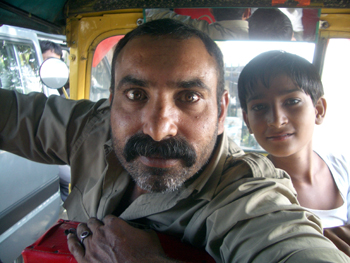
[A Delhi auto rickshaw driver and son.]
Journal by Nancy
We're leaving tomorrow, and none too soon. Delhi is wearing us all down. We picked up our vehicles today, and we're at a nicer hotel tonight. Tomorrow will be an early departure.(N.O.)
| Logbook for September 10th, Day 314 | ||
|
Start: Delhi, India Time: N/A N: 28* 32.514 E: 77* 25.042 |
Finish: Delhi, India Time: N/A N: 28* 32.514 E: 77* 25.042 |
Mileage: 046 |
September 11, 2004
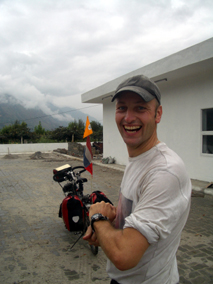
We met Coen several days ago on our way to Dharamsala. Then, today, we met him again. He's made quite a bit of progress. As we did when we saw him the first time, we fueled him up with Red Bull and wished him much luck. We're all headed toward Leh, so there's a chance we'll see him on our way back through the mountain passes. Coen is riding from his home in Holland to China.
| Logbook for September 11th, Day 315 | ||
|
Start: Noida, India Time: 7:00 a.m. N: 28* 34.264 E: 77* 19.525 |
Finish: McLeod, India Time: 1:33 a.m. N: 32* 14.085 E: 76* 19.536 |
Mileage: 362 |
September 12, 2004
We're enjoying a rest day here in the home of the Dalai Lama. Nick and Todd are busy talking to "his people" to see if we can't arrange a meeting. Tomorrow, we will either leave or stay one more day. P.S. The altitude here is around 5,000 ft, so it is cool and comfortable. We love altitude! (N.O.)
| Logbook for September 12th, Day 317 | ||
|
Start: Noida, India Time: N/A N: 28* 34.264 E: 77* 19.525 |
Finish: Noida, India Time: N/A N: 28* 34.264 E: 77* 19.525 |
Mileage: 000 |
September 13, 2004
Work continued today on our route for the rest of the expedition. Also working on a little surprise we'll tell ya'll about later... eam spent much time researching various flight options from Russia back to the U.S. We'll be flying while our vehicles are shipping. Things are good here in the home of the 14th Dalai Lama and the Tibetan Government-in-exile. It rains every day, but the air is a good temp, and the Indians, as always, are great.
| Logbook for September 13th, Day 318 | ||
|
Start: McLeod Ganj, India (Dharmasala) Time: N/A N: 32* 14.085 E: 76* 19.536 |
Finish: McLeod Ganj, India (Dharmasala) Time: N/A N: 32* 14.085 E: 76* 19.536 |
Mileage: 097 |
September 14, 2004
We had a wonderful morning here in McLeod Ganj, with the team working until noon and then departing for the Himalayas. We have some interesting stuff to tell you about in future journals! Sorry to keep you hanging?tune in next time? Our drive toward Leh (way up in the Himalayas) began in a light mist, and that mist turned into a driving movie-set-style rain that lasted until we found our hotel in the town of Mandi. We cut our drive through the curvy mountain roads short, and we will start at a reasonable hour tomorrow morning. Miss you all. (N.O.)
| Logbook for September 14th, Day 319 | ||
|
Start: McLeod Ganj, India (Dharmasala) Time: 3-ish p.m. N: 32* 14.085 E: 76* 19.536 |
Finish: Mandi, India Time: 8:45 p.m. N: 31* 41.025 E: 76* 56.549 |
Mileage: 000 |
September 15, 2004
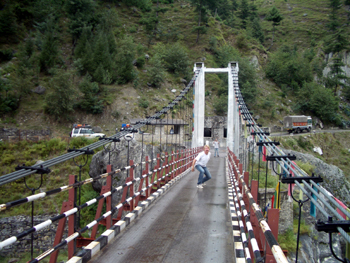
[Todd plays on a suspension bridge that hangs over an icy river. He and Matt and Nancy jumped in harmony to get this thing to bounce and sway dramatically.]
The morning started out as a modest driving day from Mandi to Keylong, a meager 219 km, but you had to earn these kilometers?more on that later. I was still on a buzz from meeting the Dalai Lama, so all was good! A 9:00 a.m. rollout was planned, and we were going to have a nice driving day into the Northern Mountains of India, the foothills of the Himalayas.
I rolled out of bed first, as I had some maintenance to perform on the vehicles, Matt and Nancy were real troopers to volunteer to help out. I thought an hour and a half would be plenty of time to complete the required tasks and return to my room and have a shower before departing, but I was wrong.
The maintenance started out with tightening of lug nuts, checking air pressure in the tires, and filling them as needed (the work adds up with four vehicles). The final task was to extract a quart of oil from each vehicle and replace it with fresh oil. One of the sponsorship agreements with Mobil 1 was to not change the oil during the entire 50,000 kilometer expedition. Every 15,000 kilometers, we extract a sample of oil and then mail the sample back home for analysis. Despite some of our best efforts, the oil has been accidentally changed in two out of the four vehicles. When we have taken the vehicles in for maintenance, the nice mechanics often assume we want to the oil changed in addition to whatever else we asked them to do. This happened when we took one vehicle into a dealership for an alignment check, and then another time when we took the vehicle in for an engine service light. Now we have stickers everywhere saying do not change the oil, and one of us usually acts as a sentry in order to protect and maintain our agreement.
Anyway, with two of the vehicles especially, we have watched the oil get blacker and blacker. It was getting to such a stage that Mobil One suggested that we remove a quart of old oil and replace it with fresh stuff, they went on to suggest that we overfill the vehicle, for a reason I am not so sure about. The dusty conditions that we often find ourselves in have contributed to dust in the engines and the engine oil.
Generally, when we take oil samples, we have a little pump that Mobil One provided, plenty of tubing to run down into the oil pan from where the dipstick sits, and little 100ml sample containers that screw directly into the pump. However, the best we could do for containers for oil samples were one-liter water bottles, and these did not have the same size mouth or threads for the pump, therefore we had to fill nine 100 ml sample bottles and pour them into the one liter-bottles (one quart is about 950ml, and one litter is 1000 ml). The process was tedious enough, but then the rain came; uffda! However, after that painful experience, I know how to do it much quicker now!
We extracted the quarts out of the vehicles with the oldest oil first. Unbelievable! This oil is the worst I have ever seen! The oil samples came out like soft-serve chocolate ice cream. Ugh. There were clumps, but I didn?t see any metallic shavings, so that was good news.
With our sluggish way of taking samples, the rain, and that fact that we could do only one vehicle at a time, rollout moved to 11:00 AM. I thank, Nancy, Matt, Neil and Adam, for their help with this process, despite the fact we only got two vehicles done.
I am glad that we were able to put fresh oil in, but leaving the oil in as it is makes me nervous. I hope Mobile One will continue to work it?s synthetic wonders and keep our engines running smooth until we arrive home.
Anyway, we rollout at a rainy 11:00 a.m., but not as rainy as when we were working on the vehicles, I might add. The drive was beautiful! I have always heard that the Kashmir area was amazing, and now we were headed to it.
Once we got on the road, the scenery drastically changed from our Delhi days. The area was not as densely populated; the road paralleled a clean rushing river, and the pedestrian suspension bridges that spanned the rivers were fun to play and bounce on. However, the roads were windy, and the drop offs were abrupt, offering new challenges to driving in India.
As we started to ascend the 13,000 ft pass, the conifer forests and the rocky rugged mountains made me feel almost as if I was in the Pacific Northwest, another factor that increased my homesickness after more than 10 months on the road. As I mentioned earlier, the drive was only 219 kilometers (135 miles), but this took us about 10 hours. As the crow flies, the distance was much shorter than 135 miles due the many switchbacks that gradually lifted us from 5,000 ft to over 13,000 ft.
One of the greatest things about the last couple of days was the fact that we were out of the hustle and bustle. Despite the fact that there were always people asking you for money, the crowds were not as intense as they were in Delhi, and the headache of doing business was much reduced, although the variety of food and services was diminished as well.
It was almost unnoticeable how the auto rickshaws disappeared as we headed into the hills. Although these Vespa-turned-passenger-carriers were a great way to get around in cities, when you are driving with them they seem like traffic mosquitoes. Their agility on the road enables them to buzz around you with great ease. However, when there are so many of them buzzing here and there, you don?t always know where they will end up. They will pass you on the left or right or whatever way they can, another complication on the roads in India. All this to say we have left the headaches of the city behind and now were are in the mountains, with crystal clear streams and snowcapped peaks and John Denver on the radio--a very nice change!
P.S. - We got up early to draw oil samples from the vehicles to send to Mobil 1, check the tire pressure on each vehicle, and tighten lug nuts. It was still raining when we woke up this morning, but it was much lighter than last night. The wet weather continued through most of the day. Our route brought us over narrow mountain roads and zillions of switchbacks as we wound up over our first Himalayan mountain pass, Rhotang La. La means pass in Indian? The elevation was 13,050 feet, and it was nice and COLD! It was an absolutely beautiful drive up and over the pass, and we almost made it to our destination in Keylang before nightfall. Tomorrow will be a very long day, with 3 mountain passes, as we make our final push to Leh. It will take 16-17 hours, so we?ll be up and on the road by 4:30 a.m. in order to make all the passes in the daylight. For many of the team members, this is some of the best driving yet. The MOUNTAINS! Wish you were here. (N.O.)
| Logbook for September 15th, Day 320 | ||
|
Start: Mandi, India Time: 9:30 a.m. N: 31* 41.025 E: 76* 56.549 |
Finish: Keylang, India Time: 10:45 p.m. N: 32* 34.368 E: 77* 02.132 |
Mileage: 151 |
September 16, 2004
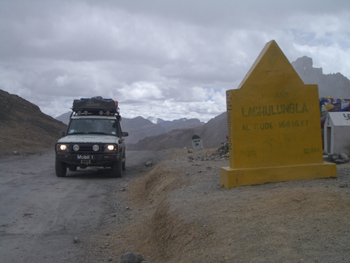
[A vehicle reaches the crest of Lachalang-la, at 16,600 feet.]
This "journal" comes to you in the form of a press release, and it is early. The release is for a few days from now, but since this is my journal day, and since I haven't written a journal yet, here you go:
KEYLONG, India, Sept. 19, 2004--Drive Around the World and Land Rover Certified have driven over the highest motorable road in the world. At a proclaimed 18,320 ft, Khardung-La is the highest mountain pass on Earth.
After driving more than 25,000 miles through 22 countries since Nov. 1, 2003 on their yearlong Parkinson?s Research drive-a-thon, the LONGITUDE Expedition team headed north, and up, into the Indian Himalayas. In this part of the Karakoram Range, the Indian Army is always on guard to protect the high-altitude borders it shares with Pakistan and China. A drive up to the Khardung-La required a special permit, and the expedition team was greeted by smiling Indian Army troops and tough-as-nails road crews working at the summit.
Signs all along the paved and winding road remind travelers to drive safely, while other strategically placed signs give insight to the immense pride of the engineers, road crews, and military who build, maintain, and protect these ?highest roads in the world.?
To reach Kardung-La, the Drive Around the World convoy of four Land Rover Certified Discoverys and eight crew members traveled 362 miles north along the well-known Manali-to-Leh Route. This road, the second-highest in the world according to India, traverses four 16K-foot-plus mountain passes, with the highest, Kanglang-La, topping out at 17,590 ft.
The team had previously spent three nights at 5,000 ft, with a final night at 11 K feet before hitting the high altitudes. The team says they experienced first-hand some of the effects these high altitudes can have on the human body.
?I feel really bad,? said Take Me With You! guest Matt Candelaria, 36, of Los Angeles, Calif., at around 16,000 ft. Candelaria is traveling with the team as their guest throughout India.
Experiencing symptoms of Acute Mountain Sickness, which indlude headache, dizziness, nausea, euporia, and diminished appetite, Candelaria just wanted to ?lose altitude.?
The quickest way to do that was to continue ahead to Leh, which sits at about 11,500 ft up in the Indian Himalayas.
The roads were narrow and crowded with slow-moving trucks and buses, but the team climbed and descended easily, clearing all the mountain passes before dark, and reaching their destination at Leh just after nightfall.
In Leh, the team and Candelaria adjusted to the high altitude while researching permits for the Khardung-La Pass, just 16 miles to the North.
?This area and several others near India?s borders require a special travel permit,? said expedition leader and Drive Around the World founder Nick, 36, of Upland, Calif..
With permit in hand, the team, including Candelaria, but minus three who were feeling mild altitude sickness, drove the steep switchbacks up to the summit at Khardung-La. Their GPS and altimeter reading 17,700 ft, the team questioned the validity of the road?s 18,320-foot claim.
?The locals and the tour guides here say the pass isn?t really 18-three, but who cares,? said Nick. ?This is the highest we?ve ever been, and we?re out of breath. The guys who built these roads are amazing.?
From Leh, the team is headed through China, Krzykstan, Khazakstan, Russia, Alaska, and Canada, before their expected return in Dec.
?This is one of the most beautiful stretches we have driven on this expedition, and we?re soaking up in every minute of it,? said Nick. ?As much as we want to get home, we know we?ll miss these places when the journey ends.?
LONGITUDE Expedition team members include Nick, 36, of Naperville, OH; Chanda, 33, of Visalia, Calif.; Todd, 35, of San Gabriel, Calif.; Adam, 31, of Saratoga, Calif.; Neil, 31, of Danville, Calif.; Colin, 25, of New Paltz, New York; Justin, 31, of Witchita, Kansas; and Nancy, 31, of Southlake, Texas.
P.S. - We woke up and hit the road by 4:30 a.m. It was an early start, but the mountain passes we were headed for on the second highest motorable road in the world necessitated our early rise. Our drive to Leh was one of the most beautiful of our entire journey. Some say it was the most beatiful, period. It brought us through our first Himalayan experience, and we won't soon forget it. We encountered four high-mountain passes, and our Take Me With You! guest, Matt Candelaria, even experienced some Acute Mountain Sickness, or AMS. Actually, I'd say we all experienced a degree of AMS, for not one of us was acclimatized to the altitudes we encountered on our route. During our 15-or-so-hour drive, we went from 10,990 ft at Keylong, to 16,050 ft at our first pass (Baralacha-la), to 16,620 ft at the next pass (Lachalang-la), to a peek height of 17,590 feet at our final and highest pass, Tanglang-la. THAT is some serious altitude! The passes were cold, but not very snowy, and they were just beautiful. We skittered down out of the mountains, losing 4000 feet in one hour, to arrive at a wonderful altitude of 11,100 ft of relief in the town of Upshi before continuing the final 45 km to Leh, which stands at a relatively comfortable 11,500 ft. Tomorrow, we will attempt to arrange permission to visit the highest road in the world, at more than 18,000 ft. (N.O.)
| Logbook for September 16th, Day 321 | ||
|
Start: Keylong, India Time: 4:30 a.m. N: E: |
Finish: Leh, India Time: 6:45 p.m. N: E: |
Mileage: 223 |
September 17, 2004
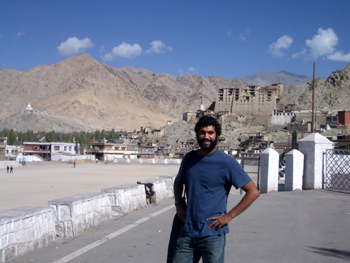
[Neil stands in front of the world's highest polo field here in Leh. It's at around 12,000 feet.]
Recent readings
The following is a list of most of the books that I?ve read since Australia. I say ?most,? because I?m sure I forgot some of the less-significant ones. I read a lot, and sometimes some books don?t make it into my long-term memory.
Jetlag Guide: Moldavia
This is a hilarious spoof on guidebooks. It tells you everything you need to know about the fictional country Moldavia, a land without modern dentistry. It?s a great read, although you wouldn?t really read it cover to cover, which is kind of nice because you can open it to any page and have a good laugh.
A Passage to India, E.M. Forster
This is one of those classic British Empire ex-pat novels. Kind of in the same vein as Burma Days by Orwell, it deals with the relationship between native Indians and English subjects, often talking about ?the club,? another theme that lays heavy in Burma Days.
Sometimes A Great Notion, Ken Kesey
This is a pretty good book, although a bit of a hard read. It centers on the life of a few generations of a family in Oregon. It starts off a little slow and confusing, but picks up towards the end. I think Kesey was taking a lot of LSD when he wrote this one, because it?s really all over the place.
East of Eden, Steinbeck
I liked this one a lot; it?s one of those books that?s really hard to put down. Apparently it is semi-autobiographical. But it is very typical Steinbeck, sad ending and all.
The Drifters, James Michner
Another good one by Michner. Much different from the other books of his that I?ve read, although still very gripping. Written from the very believable point of view of an older guy that befriends a group of hippy-types during the sixties in Europe. It takes place in a lot of places I?ve always wanted to visit, like Spain and Turkey, so I really enjoyed it.
First They Killed My Father, Luang Ung.
A young girls? first-person account of the Khmer Rouge invasion of Cambodia. We picked this one up from an annoying kid in front of Angkor Wat who was crying her eyes out because we wouldn?t buy her book. Well, Adam bought it, and we all read it. It?s OK.
Children of the Killing Field, Various Authors
This one is a compendium of various survivors accounts of the killing fields. It?s OK, although all the stories are pretty much the same. I bought this one from another little kid in front of Angkor Wat, who, early in the day, drew a picture for me. I tried to turn it down, knowing that it meant that I would have to buy something from her, but when I walked away, she gave the picture to Chanda to give to me. So I was stuck. She asked me my name and I told her it was Jellybean Joe Joe. She asked if I wanted to buy a book, and I said No. She then asked if maybe later, I would want buy one. I told her probably not. Anyway, on our way out of the temple I hear her yelling my name, ?Jellybean Joe Joe! Jellybean Joe Joe!? I tried to escape, but to no avail. She cornered me and began trying to get me to buy her book. I didn?t want it, and she started to cry. I hopped in the car, and within minutes I was surrounded by about a hundred kids berating me and flipping me the bird, all calling me a liar, and there, right outside my window was the girl who had drawn the picture, crying her little eyes out. I?m still not sure if the tears were genuine, but they were enough. So I bought her book, thinking it would get me out of that predicament, but it didn?t. I sat there with kids yelling at me for another twenty minutes before we could get out of there. It was an ugly scene, but hey, I got a book out of it.
Among Insurgents, Shelby Tucker
This is the most interesting non-fiction book I?ve read on this trip. It?s about two guys who, in the late eighties, decided to walk across Burma, which at the time was totally illegal, and pretty much still is. Within a few days, they run into a rebel army and end up spending their entire time in their company. Tucker is pretty much insane, but his writing gives people a glimpse into a part of Burma that no one really gets to see. Of course, it really doesn?t paint a very good picture of the Burmese government.
Stranger In a Strange Land, Robert Heinlin
One of the best SciFi books I?ve read in years. In fact, I think it?s one of the best books I?ve read this whole trip. Truly insightful and interesting, and it?s in that Billy Joel song ?We Didn?t Start the Fire.? The book has some great lines in it, and Heinlin invented some amazing vocabulary for the novel. Most notably the verb Grok, which Neil and I use all the time now.
One Hit Wonderland, Tony Hawks
This is a comedy/travel book by an English comedian who takes a bet that he can get a chart-topping single within a year. It?s pretty funny, and definitely worth a read. I found my copy in a Bangkok bathroom.
Filth, Irvine Welsh
Written by the guy who wrote Trainspotting, I?m sure this is a great book, however, It is seriously hard to read. It?s written pretty much all Scottish slang, and after about 20 pages I gave it up for an easier book.
Then and Now, Joseph Heller
Well, I?ve always wanted to read Catch-22, but I never find it in book exchanges, and I?m pretty cheap as far as buying books is concerned, so I have yet to get to it; however, I did manage to score Heller?s autobiography, Then and Now. It?s pretty good; unfortunately it draws a lot of parallels between his life and the characters in his books, but since I haven?t read any of them, that whole part of the book passed me by.
Jitterbug Perfume, Tom Robbins
The master of sentence construction and dirty mindedness, Robbin?s books always entertain me. He always manages to somehow fuse seriously intense subjects with copulation and debauchery, and he does it well. His descriptions are great, and the characters are always interesting. This one deals with the theme of everlasting life.
The Secret Life of Bees, Sue Monk Kidd
I borrowed this book off of Nancy. It is a total chick book, but very good all the same. I can totally see it as a movie with Oprah as one of the starring roles. In fact, I?m surprised it hasn?t been shot yet. Anyway, it?s set in the civil rights days and deals with a group of women overcoming this and that. Good stuff.
Bel Canto, Author?s Name Forgotten
Got this one from Kathryn in Bangkok. It takes place in a fictional Latin American Country. It?s all about opera and kidnapping, and it?s pretty good. In fact, I couldn?t put it down and was very pleased with it, until the end, which is no good at all. Maybe you shouldn?t read it.
Holidays in Hell, P.J. O?Rourke
This is a hilarious collection of travel stories, all written by a comedic genius/madman. O?rourke?s travel stories do not take you to the average places, but rather to more interesting locales such as Beirut. This one is a definite must-read.
To The Hilt, Author?s Name Forgotten
Standard bubblegum mystery stuff. Based in London and Scotland. The kind of book that has a cheesy glossy picture of the author in a silly English outfit on the back cover. Nothing worth remembering, but it kept me entertained for a few nights.
Anyway, I know there are a few others too, but I can?t remember them at all, so I?m sure they are not worth remembering nor mentioning.
P.S. - We had a good night's sleep in Leh, at a comfortable hotel (Bijoo), and woke up early enough to try to accomplish some tasks that Nick had laid out last night. We wanted to arrange a trip to Marsimik-la, which, at 18,632 ft, is the world's highest pass. We spent the day trying to arrange a restricted area permit for this pass, which is very close to the China border and very tightly monitored. NOBODY is allowed on this road. Had we known about the restrictions earlier, we would have put in a request through the government of India while in Delhi, but we didn't even know about the road until we left Delhi. So, after a long and hard-fought battle, we finally rose the white flag and surrendered. Tomorrow, we will travel over what Guinness Book of World Records touts as the world's highest motorable road, Kardung-la. At 18,380 ft, it's no small potatoes. We will take sponsor pictures and do some filming up there. (N.O.)
| Logbook for September 17th, Day 322 | ||
|
Start: Leh, India Time: N/A N: E: |
Finish: Leh, India Time: N/A N: E: |
Mileage: 000 |
September 18, 2004
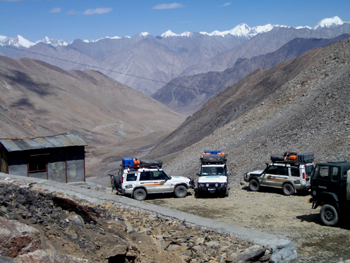
[The convoy at the top of the highest motorable road in the world, Kardung-la Pass.]
[Kardung-La is said to stand at 18,300 feet, but our Garmin GPS indicates 17,600. Locals say the GPS is correct.]
We rose at 7:30 for an 8:30 departure to the permit office to pick up the documents necessary for traveling to Kardung-la pass, on the world's highest motorable road. Some of the team isn't feeling well enough to make the 50-km trip, so only Nick, Chanda, Neil, Todd, Nancy, and Matt went, driving in vehicles D1, D3, and D4 with our guide, Amjad. We finally left the permit office at about 9:45, and we were on our way. We had to sweet-talk the guards at the checkpost, whose job it is to prevent anyone from heading up the mountain after 10 a.m. (we reached the checkpoint at 10:15, but we had the blessing of the second-in-command to pass through late). It was a quick jaunt up to the peak, which, according to our Garmin GPS, local knowledge, and our guide, was really at about 17,700 ft, versus the touted 18,380. Fine with us. We're still not acclimated. We spent way longer than an hour up there, and everyone felt fine. Nancy and Amjad rode the Santa Cruz mountain bikes down, enjoying a free-ride of about 1.5 hours to beat the Land Rovers home to Leh. It was an amazing experience, and the team is in love with Leh and the Himalayas. Unfortunately, we have to leave early tomorrow to head back toward Keylong and Manali. We have to (get to) transit the same route we took up here, over four high-mountain passes. Awesome. It'll be a long and rewarding day. (N.O.)
| Logbook for September 18, Day 323 | ||
|
Start: Leh, India Time: N/A N: E: |
Finish: Leh, India Time: N/A N: E: |
Mileage: 034 |
September 19, 2004
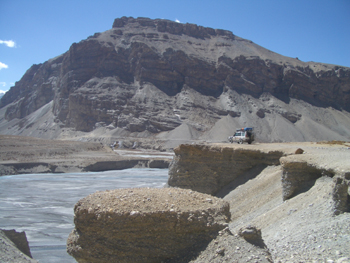
[Vehicle D3 peers over a huge gorge on the drive from Leh to Keylong. It's quite a drop down to an icy river.]
We had a wonderful drive back over the high passes, this time driving south from Leh to Keylong. The drive was speedy, and we enjoyed a whole new perspective on the mountains as we approached them from a different direction. Tomorrow we will head back into the lower areas of India, where the air will be thick with oxygen, and the heat will remind us what it's like to sweat in the Indian heat. (N.O.)
| Logbook for September 19th, Day 324 | ||
|
Start: Leh, India Time: 4:30 a.m. N: E: |
Finish: Keylong, India Time: N/A N: E: |
Mileage: ??? |
September 20, 2004
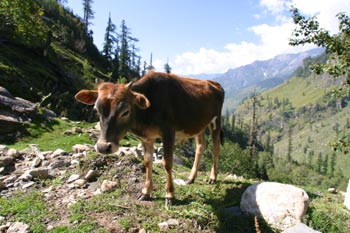
[A lonely calf provided more than 15 minutes of entertainment to Neil and Adam during the team's drive toward Keylong.]
Today the sun decided to shine, and it made the drive back across the Himalayas towards the Indian and Pakistan border a dreamy drive. We woke up really early today, about 4:30 a.m., and were on the road by 5 a.m. A few hours after we left, we started ascending the pass, and it was gorgeous. It was also extremely dangerous as well, with sheer drops of a thousand feet or more to certain death, not to mention narrowly scraping constantly along the narrow roads amongst huge cargo trucks. Every corner you come up to, you need to honk your horn and go very slowly. It is a one-lane road, and sometimes we had to back up until there was shoulder enough to pull onto so the truck going uphill could pass. The whole time the trucks are passing our cars, we are looking over the edge of a very long drop off and praying that the cement or rock won?t give away. And luckily, it hasn?t.
Aside from the sketchiness of the road, the beauty is overwhelming. You can see down the entire valley, filled with pine trees, wild flowers, horses, cows, snowcapped mountains, and windy roads dissipating into the distance. Along the way down, Adam and I stopped for some masala tea and chatted with a local man who had his vending station right next to a waterfall. What a lucky place to work from. This was not your average job in India. Later on, we came across the cutest calf as well. We stopped and mooooed at him for 15 minutes. He would mooooo back and we would mooooo at him, and so on for a while; it was really funny. I guess you had to be there, but it was so serene and peaceful we just couldn?t get away from the little guy.
And of course, a day this beautiful can?t be filled with pure pleasure, there has to be something that goes awry, and sure enough it did!
Nancy, our sweetheart mountain biker, loves to get to the top of mountain passes and speed all the way down in front of our convoy, and then we pick her up at the bottom. Well today, she decided to take on this mountain with super windy curves, construction workers, death defying cliffs, and all alone! We weren?t scared for her though, actually just really stoked for her; she loves this!
So as we drive down the pass and enjoy the amazing scenery, we finally come down to the bottom of the mountains to Manali and go to the gas station, where we normally would all go and meet to fill up. Well, when we arrived 2 ? hours later, Nancy wasn?t there! So we started looking around for her and weren?t worried because we thought she must just be somewhere we didn?t see previously. But after 30 minutes of searching, the worries really began. Adam and I checked back up the mountain, and Todd went to check the hospital, and Colin and Justin checked on past the town, but no one was having any luck, and I was really beginning to actually contemplate the unimaginable. It is amazing what your mind can do to you in these situations.
I started thinking about all the cliffs and hairpin turns and thought there was a possibility she got nailed head-on by a truck and went over the edge and got seriously injured, or even worse, died! I mean come on, there is no way she could actually die, that is crazy!! No way!! Well, after an hour of searching, the crazy thoughts start becoming more and more scary and possible. We were showing people her picture that we had on our laptops, and no one was recognizing her.
Finally, Todd radioed us and told us he found her, phew!! I guess she had missed a turn over a bridge, and went the wrong way. The funny thing was that when Todd arrived and found Nancy, she was wondering where the heck we were the whole time! But as soon as she saw Todd?s face, she knew we had been looking for her and asked , ?Am I in trouble??
And boy oh boy, we would have scolded her if it had taken us a half hour to find her, but since it took over an hour and we all started having such vivid imaginations, we were all ecstatic and happy to see sweet Nancy alive and very embarrassed, and even with some tears.
Neil
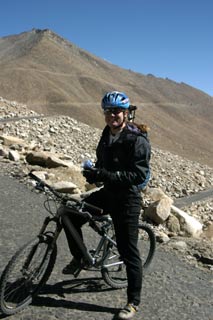
Nancy pauses during her long downhill ride from almost 18,000 feet at Khardung-la Pass, the highest motorable road in the world.
P.S. - It was a very long drive from Keylong toward Amritsar. We were too tired to make it to our destination, so we found a nice hotel along the way and stopped for the night in Phagwara. We had a downhill drive from the mountain pass (Rhotang-La) near Keylong all the way down to a valley just 900 feet above sea level. It was a winding switchback, and the truck traffic was heavy. We're exhausted, but we're happy and well. Nancy rode her Santa Cruz bike downhill for 55 km from Rhotang to Manali, and the meeting point was botched. The team spent an anxious hour searching for her until they found her sitting and waiting at the first gas station in town...except that the first gas station in town was just after the first right that the rest of the team had taken to drive to another "first" gas station in town. Oh well. Wups. (N.O.)
| Logbook for June 20th, Day 325 | ||
|
Start: Keylong, India Time: 4:30 a.m. N: E: |
Finish: Phagwara, India Time: N/A N: E: |
Mileage: ??? |
September 21, 2004
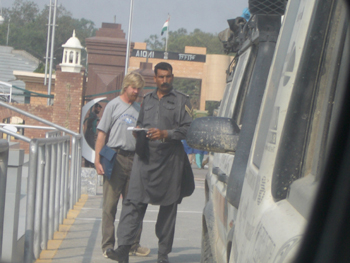
[Todd and a Pakistani customs official inspect the vehicle tag numbers before crossing into Pakistan.]
We had a short driving day, and we ended up lodging for the night in the most comfortable and most luxurious hotel we've seen in ages. The showers have doors. The bed covers can be touched and even sat upon without fear. There are no bugs or geckos in our rooms. We're happy and well, but I'm not ready to tell you where we are. (N.O.)
| Logbook for September 21st, Day 326 | ||
|
Start: Phagwara, India Time: 4:30 a.m. N: E: |
Finish: Lahore, Pakistan Time: N/A N: E: |
Mileage: ??? |
September 22, 2004
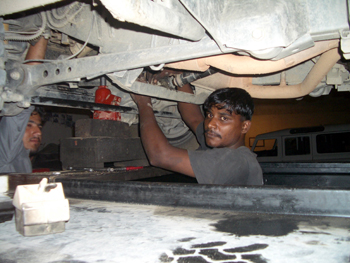
[A Land Rover mechanic looks at the undercarriage in Lahore.]
After staying at a 5-star hotel, the team met up with our Pakistan guide, Riaz, for the journey north. Team made an unplanned stop in Islamabad to repair a broken motor mount on D2. Team also picked up additional spare parts. Due to the late hour, the team stayed overnight in Islamabad. (N.O.)
| Logbook for September 22nd, Day 327 | ||
|
Start: Lahore, Pakistan Time: 12:00 p.m. N: 31* 13.855 E: 75* 45.530 |
Finish: Kohima, India Time: 10:15 p.m. N: 33* 42.588 E: 74* 03.094 |
Mileage: 287 |
September 23, 2004
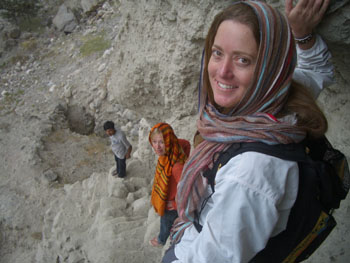
[Nancy and Chanda all wrapped up in Pakistan.]
This blog will be short, because I?m at a restaurant, and people are looking over my shoulder. NOT COOL! They don?t speak or read English, but I?m touchy.
So, we?re driving through the Northern Areas of Pakistan, and it is quite an experience. It?s a little bit unsettling that our guide, Riaz, a native of Hunza in the Northern Area, feels like we must choose our stops and activities very carefully. When we have to make a bathroom stop, he makes sure we stop only at fancy, approved hotels. He says there are people in these parts who do not like Westerners, and that we should say we are from Canada if asked. I vowed I would never say I was from Canada, but I realize that I don?t have that right when traveling with a group. If, by saying I am an American, I can somehow endanger or jeopardize our group, I will, with great pain, say am a doggone Canadian. No offense to you fine neighbors to the north, but I am too proud of my country to feel at all comfortable saying I?m from anywhere but the U.S. I doubt I am very convincing, after all.
We met a busload of schoolchildren, boys and girls, and we had so much fun snapping pictures with them, shaking hands, and giving high fives. We each had so much fun that I just really wanted to let them know that we are Americans, so their perception of us could be based more on experience than schoolbooks and media. But we all lied and said we?re from Canada. So now they all have a wonderful perception of Canadians. So, you?re welcome, Canada. And I am sorry, U.S.
In these parts, the people are extremely conservative. There are few, if any, women visible in the streets. Although there are hundreds and hundreds of men out doing their business, I have seen but three women. And when I say I have ?seen? them, what I mean is that I have recognized their presence. You can see them in the same way you can see a person hiding beneath a down comforter; they?re there, but that?s all you know. Remember when E.T. dressed up as a ghost for Halloween in order to sneak past Elliott?s mother? He was covered from head to toe, and all you could see were his big clown shoes. Well, E.T. had it good. He had holes for his eyeballs. These women have neither big clown shoes nor holes for their eyeballs. Their viewing slits are covered in dark mesh so that they can see out but nobody can see in. It must be hot under all that garb. I?m not judging either, because maybe they like it, but I sure wouldn?t.
Chanda asked where all the women are, and Riaz informed us they are in their homes. They do the housework and keep the home, washing, cleaning, cooking, minding the children, and what have you. I suspect, like most women, they also spend a bit of time gossiping with their neighbor ladies who are also at home doing the household chores. I mean, women are women, after all.
So, we drove north along the world?s most beautiful highway (the Karakoram Highway is smooth, and it passes through the most beautiful countryside I?ve ever seen). Pakistan is stunningly beautiful, and the weather has been perfect. The only problem is time. I look out at these incredible mountains, and I long to go to the top of them. But there?s no time for that. Oh, and the only other problem is that Chanda and I have to cover up from head to toe, with long pants, long sleeves, and scarves on our heads. It?s a small price to pay for a visit to this incredible country, and we don?t wish to offend.
P.S. - Team made early rollout from Islamabad to the Karakoram Highway. Riskiest section was through Pakistan?s Northern Area, which shares a border with Afghanastan (about 235 mi away) and is a known area of support for the Taliban and Al-Quaeda. There were only one or two women on the street, and those we saw were covered from head to toe, without even their eyes showing. Team followed the Indus River most of the day through the Karakoram Range in the Himalayas. (N.O.)
| Logbook for September 23rd, Day 328 | ||
|
Start: Islamabad, Pakistan Time: 6:20 a.m. N: 33* 42.588 E: 74* 03.094 |
Finish: Chillas, Pakistan Time: 8:30 p.m. N: 35* 25.888 E: 74* 06.033 |
Mileage: 273 |
September 24, 2004
Team pressed on through safer areas of Pakistan within the Himalayas? Karakoram Range. Roads were in amazingly good condition, and the weather was cool and clear. A late push at the border enabled the cars to clear customs. Team will exit Pakistan tomorrow.(N.O.)
| Logbook for September 24th, Day 329 | ||
|
Start: Chillas, Pakistan Time: 7:15 a.m. N: 35* 25.888 E: 74* 06.033 |
Finish: Sost, Pakistan Time: 5:00 p.m. N: 36* 41.312 E: 74* 49.260 |
Mileage: 180 |
September 25th, 2004
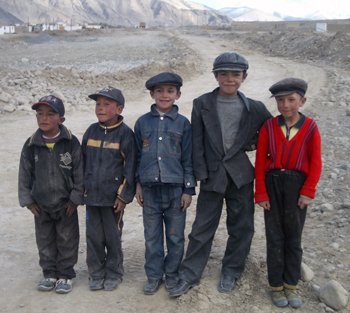
[Boys who live near the pass that separates Pakistan from China line up in military fashion for a photo. We seriously love their fashion sense!]
Team bid farewell to our friend and guide, Riaz, and entered China through the Khunjarab Pass. A delay at the Chinese checkpoint cost the team more than two hours. Upon arrival at immigration, we were told our visas were expired for the second entry into the country. Our cars were impounded, and the team walked to the hotel while our guide, Abdul, worked to sort things out. (N.O.)
| Logbook for September 25th, Day 330 | ||
|
Start: Sost, Pakistan Time: 8:30 a.m. N: 36* 41.312 E: 74* 49.260 |
Finish: Tashikurgan, China Time: 10:00 p.m. N: 37* 45.998 E: 75* 13.617 |
Mileage: 126 |
September 26, 2004
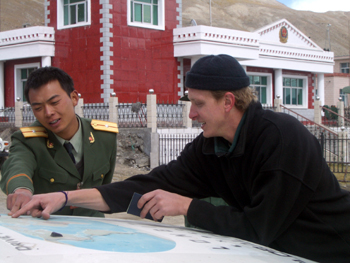
[Justin points out our route to a Chinese immigration official. The niceties didn't work, however, as we were deported the very next day.]
The team walked back to immigration in the morning expecting to clear things up with the visas and head further into China. The officials, typical of China?s affinity for good order and discipline, were unbending. As a result of a line on the visas that said ?Enter before Sept. 11, 2004,? we were officially deported from the People?s Republic of China and forced to drive back to Pakistan. Todd and Nick (for safety reasons, no women are allowed on this mission) drove back to Islamabad with Riaz in D3, while the rest of the team remained overnight at our familiar Sost hotel. Tomorrow, while the boys are still driving to Islamabad (16 hrs away), we will move to Hunza to wait it out. Hunza is safe and beautiful. (N.O.)
| Logbook for September 26th, Day 331 | ||
|
Start: Tashikurgan, China Time: 10:00 a.m. N: 37* 45.998 E: 75* 13.617 |
Finish: Sost, Pakistan Time: 5:45 p.m. N: 36* 41.312 E: 74* 49.260 |
Mileage: 126 |
September 27, 2004
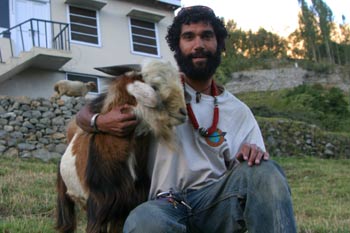
[Neil poses with his new best friend.]
Who would have thought that getting denied at the Chinese border would be a good thing? Well, I guess it wasn?t, but today, the day after our denial, being back in Pakistan was a very pleasant one??? for some of us.
Poor Nick and Todd left last night after dinner to drive more than 16 hours all the way back to Islamabad to get new Chinese Visas. They were not excited about that at all. Luckily, our previous guide, Riaz, was still around and met them just a few hours into their drive. We haven?t heard from them yet, so I am assuming they haven?t arrived. It is going to be a long journey; thank goodness we received a huge shipment of Red Bull the other day.
As for us, we woke up today and drove a couple hours to the town of Hunza, which is a beautiful mountain town in the middle of the Karakoram Hwy. We are staying just above Hunza in tiny town called Karim Abad. Mountain peaks in every direction surround us and it is extremely peaceful and quiet.
The rest of the team decided to drive a couple of hours towards Gilget to use the Internet, and I stayed behind by myself and sat on a cliff edge and played some guitar while overlooking the most scenic mountains ever! Then the local antique store owner here, a young man named Anwar came up to me and sat down. We chatted for a few hours and picked some local grapes and stuffed our bellies. He is actually from Afghanistan and lives here for half the year when trekkers come to hike the local mountains and buy his merchandise. He is a really nice guy, and I asked him all kinds of questions about his view on America.
Now as you all know, Afghanistan is where the Taliban came from. We gave them guns and ammunition and put them in power there back in 1979 or so, then they went crazy and we ended up air striking them in 1996 and ousting them from power. Anwar said that he loves Americans, and he is so happy that we ousted the Taliban. He really likes the new man in power now. He also says that many foreigners travel to Afghanistan and tourism is picking up.
He doesn?t have many friends here, just one really. He has eight brothers, and they are spread all over the world, including a few of who are antique dealers.
After hanging with Anwar for a while, I went for a walk as the sun was setting and I spotted some goats and hung out with them. Their owner came by and we ended up talking for an hour, too. He and his brother are really cool guys. They are farmers and live on this sweet plot of land overlooking the mountains with a stream running through it. I believe his name was Marab, and he has three brothers; one reads, one drives, and the other one works on the farm. He was really friendly and grabbed his goat and then told me to come over and take a picture with him. It was pretty funny, as this goat didn?t really like to be held too much. However, after I held him and let him go, he kept coming back up to me and rubbing my leg and jabbing me with his horns!
The people I have met in Pakistan are very friendly, and it is hard to imagine there are so many fundamentalists and hard-core religious fanatics that cause such terror and fear for most Americans. The truth is, there are parts of Pakistan that are very dangerous, yet most of Pakistan is beautiful and very worth visiting. The Pakistani people are just people, just like you and me. And like everywhere in the world, there are some crazy people whom the media focus on and terrify the rest of the world by only showing those small negative incidents on TV news constantly. We have been traveling through many parts of the world now which have TRAVEL WARNINGS, and which the news always portrays as being very dangerous; however, the reality is very different from what you see on TV. The only way to really judge is to come over here yourself and check it out.
Of course, some areas of the world are extremely dangerous, and I wouldn?t go near if I were paid very large amounts of money, such as Iraq!
Well, I hope Nick and Todd are alright and they call us soon to let us know they have arrived in Islamabad. Until then, I will continue to soak in the beautiful mountainous surrounding Pakistan and its people and animals. In fact, right now, the moon is shining right over the mountain top! MMMnnnnn.
Neil
P.S. - We got up lazily, ate, and drove to Karimabad, which is a small city in Hunza. We checked into a great hotel, the Hotel Mountain View, and settled in for a while. We spent a restful day in beautiful Karimabad while Nick and Todd mysteriously handled things south, in Islamabad. We hope things are going well for them. In the meantime, we are making new friends here and enjoying the scenery in what might be the most beautiful place on Earth. (N.O.)
| Logbook for September 27th, Day 332 | ||
|
Start: Sost, Pakistan Time: 10:30 a.m. N: 36* 41.312 E: 74* 49.260 |
Finish: Karimabad, Pakistan Time: 12:30 p.m. N: 36* 18.979 E: 74* 40.051 |
Mileage: 50 |
September 28, 2004
[Boys chase our vehicle through their village near Karimabad to catch a ride on the bumper. We had tea and dinner with their wonderful family, and it was a highlight of our journey.]
Another great day in beautiful Karimabad, God?s country. Everything is perfect here: weather, views, people, health. It is believed that this is the lost city of Shangri La, where the people are known to live well into their 100?s. Why? Well, they think it?s the apricots. You get an extra day of life for every apricot you eat. We?ve been eating them by the handful (dried). (N.O.)
| Logbook for September 28th, Day 333 | ||
|
Start: Karimabad, Pakistan Time: N/A N: 36* 18.979 E: 74* 40.051 |
Finish: Karimabad, Pakistan Time: N/A N: 36* 18.979 E: 74* 40.051 |
Mileage: 000 |
September 29, 2004
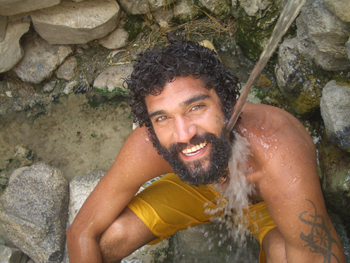
[Our new friend, Dawood, brought us to see the hot springs that bubble up out of the ground near his village. Here, Neil seizes the moment to take a hot shower.]
| Logbook for September 29th, Day 334 | ||
|
Start: Karimabad, Pakistan Time: N/A N: 36* 18.979 E: 74* 40.051 |
Finish: Karimabad, Pakistan Time: N/A N: 36* 18.979 E: 74* 40.051 |
Mileage: 000 |
September 30, 2004
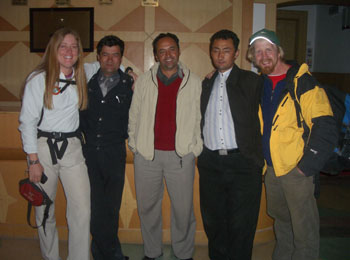
[Members of the bike-search team, from left to right, Nancy, Maktar, Niyat Ullah, Columbo, Todd.]
Today being Thursday and all, I?m supposed to write about our final day in Karimabad. But truthfully, since I never actually write my Thursday journals on Thursday, I?d rather write about the much-more-exciting things that happened Friday and Saturday. Instead of writing about how we kicked around in town and bid farewell to all of our new Hunza friends, I?d rather write briefly about how we left Karimabad the following morning and drove to the Pakistan border town of Sost to meet up with Nick and Todd. If tomorrow were my journal day, I?d talk freely about how we passed through customs and immigration there, for the second time, and drove up and over the Khunjerab pass?again. Somehow, I?d fit in a road description for that section of the Karakoram Highway (smooth and paved until after the Chinese checkpoint on the East side of the pass, winding and beautiful on the way up, straight and gradual on the way down; the road turns into a big mess for most of the Chinese side), as per Nick?s new journal rule. Then I?d to talk about clearing Chinese immigration and having the vehicles impounded in the customs yard because our license tags and travel permits expired while we were organizing new visas. But Colin will probably tell you about all that in his Friday journal.
Something so personally horrifying and unimaginable happened Friday that I cannot help but usurp some of Colin?s Friday privileges (and even some of Justin?s Saturday privileges) to describe what, to me, has been the most tragic event of the expedition.
The road from the Khunjerab Pass (dividing line between Pakistan and China) to the Chinese border town of Tashikurgan has been completely ripped up and is under construction. It is one of the bumpiest and dustiest we?ve yet to encounter. Migrant road crews are spread out along the entire length of the road, pushing dirt around and making rock piles. Basically, the whole road is one big, bumpy detour. Well, somewhere along that lovely stretch of road, D1 made a $4,000 deposit, for when we arrived at the Chinese customs parking lot, we realized that the whole spare tire assembly had snapped off the back of Nick and Chanda?s vehicle. By ?assembly?, of course, I am referring to the mounting bracket, which is (was?) attached to the spare BFGoodrich tire, to which our BVG bike rack is (was?) attached, to which our beloved Santa Cruz Mountain bike was (is?) mounted, the whole assembly being chained and locked together by Kryptonite cables and a U-lock. I looked at the naked rear door of D1, and you military types will know exactly what I mean when I tell you the phrase, ?Whisky, tango, foxtrot?? passed through my head. This was not good.
We spent an hour trying to rush the Chinese officials through our check-in process, but they weren?t too impressed with our sense of urgency. I knew one of the truckers or one of the villagers behind us on that road were going to seize every moment we wasted to haul their $4,000 prize off the highway and into hiding. After what seemed like an eternity, Justin and I were allowed to depart in D3 with our issued Chinese guard to backtrack in search of our lost expedition gear.
We searched the dark night with all of our Hella lights shining into the unknown. ?Put the spotlight over there, Justin. Is that just sticks, or is it my bike?? It was just sticks. This went on for three hours; an hour and a half out, an hour and a half back. To no avail. Some lucky individual had hit the jackpot. Still, though, Justin and I gave up our fruitless search with hope in our hearts, for we both believe in the kindness and humanity of the people we have met along the Karakoram Highway. Maybe somebody will realize the importance of their find and turn it all in to Chinese or Pakistani customs?We hit the sack at 2:00 a.m., exhausted.
Well, the team woke up Saturday morning, packed, and departed for customs. Todd and I decided we would remain behind to conduct a final search, if they?d let us, and the rest of the team would continue on to Kashgar via taxi. Our vehicles would remain in the customs yard until permits and licenses could be arranged.
After much ado about nothing, Todd and I were finally introduced to the Tashikurgan police, and wheels were set into motion for a solid day of searching and camaraderie. Our guide translated our needs and then left with our team, whom we would meet tonight or tomorrow in Kashgar. The police, one in uniform, one in street clothes, were eager to help, but they had no vehicle. We pantomimed that they should persuade the customs officials to allow us to use one of the Drive Around the World vehicles in the search, and we walked the two or three kilometers to the impound lot. There, the two cops were joined by a friend of theirs, a Pakistani shop owner named Niyat Ullah, who spoke wonderful English. The men adeptly persuaded customs to let us take D1 down the highway to look for our bike and tire, and the adventure began.
Because of his fine interrogation style and his American television cop persona, we nicknamed the plainclothes police officer ?Columbo.? His uniformed friend is Maktar, and that?s a name that requires no nickname. We drove down the bumpy, dusty road, stopping at every house and construction camp, and flagging down every truck we met along the way. Each time, Maktar, Columbo, Niyat Ullah, and Todd would hop out of the car and approach the potential witnesses. Oh, the skill and style with which the police officers did this! Columbo would lead, approaching each witness in a friendly but professional manner. Smiles and handshakes told me mutual respect had been achieved. The witnesses would smile, and they?d point down the road, or at our vehicle. They?d nod their heads and chat up a storm. Columbo would lean forward into their personal space and talk to them from the top of his forehead, one hand in his pocket, and the other holding a cigarette. Classic American television cop. Finally, they would all smile, shake hands, and get back into the car. ?Did they have any information? Have they seen my bike?? No, no.
This went on dozens of times, and we stopped at about five police checkpoints along the way. At each stop, our friends and heroes told the cops, workers, and villagers that a cash reward has been offered for the missing items. We cased the entire Karakoram Highway. We turned around after a witness said he had seen the four vehicles drive through, and two of them still had their bikes and tires attached. On the way back, we made a final stop at the most westerly police building, and there we found our first shred of evidence. A villager had seen the convoy at the bridge, and he had tried to yell at the last vehicle to stop, but they didn?t hear. They were dragging a bike, and it seemed badly damaged. Yikes. I wonder how long it dangled back there before it finally broke off.
After more than six hours of searching, we returned to Tashikurgan after 9 p.m. Our new friends were very sorry they?d been unable to find our missing gear, but they still had hope it would find its way back. Everybody knows about it, and they know a reward is offered.
During our search, we were informed by Niyat Ullah that the three of them had been on their way to a wedding party when we approached them with our problem. Out of a strong sense of duty and humanity, they each selflessly gave up their plans to help two perfect strangers find a bicycle and a tire that had gone missing. I mean, price aside, when it comes right down to it, we were just looking for a bike and a wheel. Big deal. But it was a big deal to them, and it was a huge deal to us, and they felt they must help.
We were all starving by the end of the search, so we went to dinner at a local place with our new friends. We got a private room , and the wedding party, their wedding party, was going on in the next hall. But our friends chose to eat with us, and at the end of a night filled with camaraderie, adventure, and warm friendship, Niyat Ullah paid for the meal we had wanted to buy for our heroes. We have the most profound respect for our new friends.
So, while we still cling to the hope that our gear will turn up again by the time we return for our vehicles in a week or so, we figure a bike and a spare tire are a small sacrifice for the friendship that their loss has brought to us. Isn?t it funny how everything seems to happen for a reason? Lose a bike, gain three friends. It was a heck of an adventure.
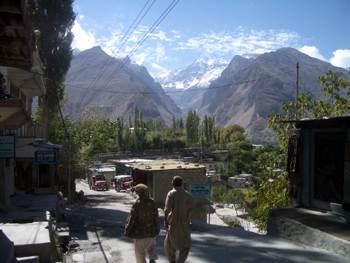
Karimabad: Quite possibly the most beautiful place on Earth.
| Logbook for September 30th, Day 335 | ||
|
Start: Karimabad, Pakistan Time: N: 36* 18.979 E: 74* 40.051 |
Finish: Karimabad, Pakistan Time: N: 36* 18.979 E: 74* 40.051 |
Mileage: 000 |
October 01, 2004
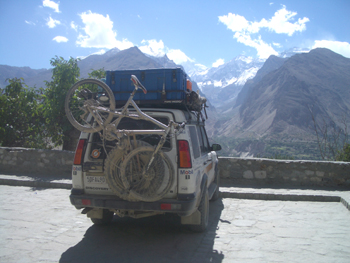
[Now you see it,]
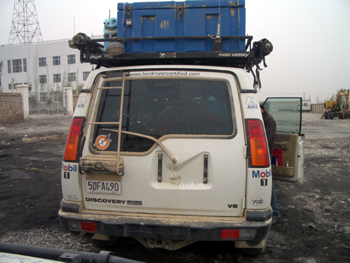
[Now you don't. The entire mount, with the Bike, rack, and spare, fell off the vehicle on a very bumpy road.]
We woke up and waited for Nick and Todd. We knew they were coming, but we didn?t know what time. We got a call and were told to get in our vehicles and drive toward Sost. We had to get there before the border closed at 11:00 a.m. So, we put two gerry cans in each vehicle and headed off, not too far behind D3 and the boys. They had our visas, but we still don?t have license plates or driving permits, because the ones we had expired while we were getting new visas? So, we made it to customs/immigration, and, in the parking lot, we discovered that the entire spare tire on D1 had broken off, taking with it the mounting bracket, bike rack, and Santa Cruz mountain bike! OH, TRAGIC DAY!!! That?s more than $4,000 worth of gear! We waited for more than an hour before the authorities finally allowed Nancy and Justin to hop into D3 with a guard and go to look for it. They looked from 10 p.m. until about 1 a.m., with no luck. The road between the pass and the actual customs building is long, bumpy, and thinly trafficked. Somebody had to have seen it and picked it up. They?ll have difficulty getting through the Kryptonite lock and cables holding the whole assembly together. We still have hope that an honest person got it and will return it. Unless one of the trucks on the road behind us got it, we still have a chance. Searching will resume tomorrow. Nancy and Justin didn?t get to bed until 2 a.m. The vehicles are in customs impound until we can get our driving permits. The team will bus/taxi to Kashgar, China, to work and wait. (N.O.)
| Logbook for October 1st, Day 335 | ||
|
Start: Karimabad, Pakistan Time: 9:30 a.m. N: 36* 18.979 E: 74* 40.051 |
Finish: Tashikurgan, China Time: ??? N: 37* 45.998 E: 75* 13.617 |
Mileage: 180 |
October 02, 2004
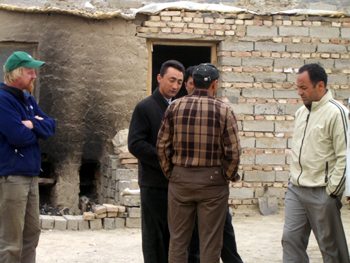
["Columbo" interrogates villagers during our day of searching for our lost bike and tire. Total loss? More than $4,000... There's a reward offered, so maybe it'll turn up.]
The gang went to customs at noon to finish checking out. Taxis were hired to take the team to Kashgar, to the east. Nancy and Todd stayed behind, and the local police helped get D3 out of customs so that they and the cops could go look for the bike. It was a great day of Columbo-style mystery solving, and althought he bike/tire were never found, they still have much hope. They celebrated new friendships over dinner and drinks in Tashikurgan, with all members of the search party hopeful that the bike will eventurally turn up (now that everybody knows there is an award being offered). The rest of the team made it to Kashgar and is waiting at the Seman Hotel there. (N.O.)
| Logbook for October 2nd, Day 337 | ||
|
Start: Tashikurgan, China Time: N/A N: 37* 45.998 E: 75* 13.617 |
Finish: Kashgar, China Time: N/A N: 39* 28.242 E: 075* 58.027 |
Mileage: N/A (by taxi) |
October 03, 2004
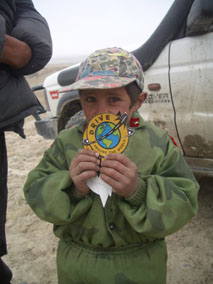
[We interrogated this little boy, but he claims to know nothing about hour missing bike...suspicious little devil, isn't he? :) ]
Nancy and Todd spent the first half of the day in Tashikurgan, looking for their new friends and finding a taxi for Kashgar. Their ride over was bumpy and uncomfortable, with both of them thinking they may have suffered internal organ damage due to a lack of suspension in the SUV taxi. It was a long 6 hours. They met up with the team at the hotel and made an early night of it. (N.O.)
| Logbook for October 3rd, Day 338 | ||
|
Start: Kashgar, China Time: N/A N: 39* 28.242 E: 075* 58.027 |
Finish: Kashgar, China Time: N/A N: 39* 28.242 E: 075* 58.027 |
Mileage: 000 |
October 04, 2004
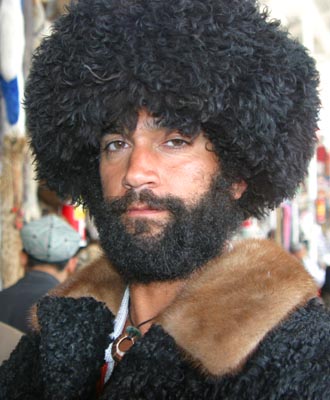
[Neil poses in his favorite new hat. We all agree it suits him to a T!]
Today was such a brilliant experience, filled with local culture and a heck of a lot of fun! Adam, Colin, and I ended up on a small bus from our hotel here in Kashgar on an hour ride out into the countryside towards a small Uighur village. It is Monday and that is their weekly day to have a local market, filled with livestock, hats, silks, shoes, food, fat-bottomed sheep, and even some camels.
When we arrived, the town was filled with people and very dusty roads, especially near where the livestock were kept. These people are the Uyrgr people, and this whole area of China, called Xinxiang, has been taken over by the Han Chinese, and the Uighurs detest the Han Chinese. China is huge, and they took this small area away from the Uighur people. In fact, in Kashgar, within the next few days, most, if not all, of the Han Chinese will leave Kashgar for the entire winter to go back to their homes in other parts of China. They only come here for the work and trade during the nicer parts of the year. Right now we are heading into their harsh winter months.
So I find myself walking around this Uighur village filled with beautiful people selling everything you can imagine. There are little girls selling bagels, old women selling apples, men repairing shoes in the dust, food vendors burning old clay ovens using local wood instead of coal, cooking delicious lakman and other local foods. Lakman is a local Uighur dish made with noodles, mutton, bell peppers, chili, tomato, onions, some leafy greens, and some other tasty spices. You can buy it on every street corner. Another ingredient that is actually the main ingredient in the local food here is the FAT-BOTTOMED SHEEP BUTTS! Yep, fat bottoms are the delicacy here, and they are pure fat. These sheep are so cute and funny looking. They walk around with their big bums swaying with every step, and the bigger the better. In fact, at the livestock part of the market, you see men and boys feeling and grabbing the sheep bottoms trying to find the fattest one. They sell for the most.
As you look around, you also see dead sheep and bulls, and all the innards hanging up. There are intestines, stomach, goat head soup, and big freshly skinned sheep bottoms ready to buy and eat. It is a bit tough to stomach at first, then you get used to it, and before you know it, you just bit into a dumpling filled with fresh sheep butts. And speaking of asses, there are plenty of donkeys pulling all the merchants and their things around town.
It really is difficult to keep this journal short, because there is so much to tell about this market. I guess you will have to come to Kashgar yourself to really experience it all. It was a bit sad to see all the goats and sheep tied up together. It is really hot here during the day and some of the goats squeal and struggle to get their head up on the back of another just for some fresh air and I know they are dying for water, poor guys.
Now the coolest part of my whole experience in this town is my HAT!!! Yesterday at the Sunday market I bought a local hat made of wool and it is a really big hat, and everywhere I go, the local people stare, smile, and laugh hysterically at me. It is great; everyone wants to wear it and touch it and trade and just make conversation. So everywhere I went all day I was meeting people nonstop and laughing and having a fun time. In fact, when the one camel came through the town during the day, there was a crowd around him, and I even managed to get the camel to wear the hat!
All the people here are genuinely friendly, and it was a really pleasant experience. We are stuck here for a week or so, and it really is a good place to be stuck, since there is interesting culture and great food everywhere.
Neil
P.S. - This is a quick hello to let you all know we have traveled through Pakistan and are safe and happy in northern China. For security reasons, I was not allowed to tell you we were in Pakistan. For reasons of really poor Internet access in the Northern Area of Pakistan, I was unable to send journal updates to let you know how we've been. We've been great. We were delayed several days by an expired visa when we tried to enter China from Pakistan, and they deported us back to Pakistan. Todd and Nick went back to Islamabad to correct the visas while the rest of the team remained in the Northern Area. We all fell in love with the friendly people and the beautiful countryside of Pakistan during our stay there, and I must say we all felt quite sorry to leave. Most of us agree that the Pakistanis we met in Hunza in the north are some of the most friendly, most beautiful, most gracious people we have met on the entire expedition. We made a lot of friends in the village of Karimabad in Hunza, and we miss them already. Now, we are in China awaiting driving permits so we can continue to Kazakhstan and Russia. Everybody is healthy and in excellent spirits.
Everybody has a lot of work to do here in Kashgar, especially in the vein of Internet and visas/permits, so each did his/her own thing. In the evening, Chanda and Nancy spent some time with some travelers from Australia and Canada. (N.O.)
| Logbook for October 4th, Day 339 | ||
|
Start: Kashgar, China Time: N/A N: 39* 28.242 E: 075* 58.027 |
Finish: Kashgar, China Time: N/A N: 39* 28.242 E: 075* 58.027 |
Mileage: 000 |
October 05, 2004
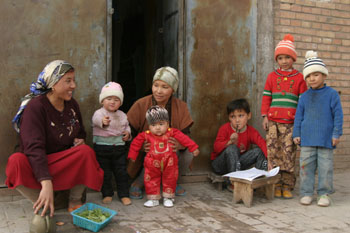
[Uighur ladies and children in Kashgar.]
Another busy day doing our own thing. The big news is that we were able to find a bank (Bank of China) that will give money on credit card advance. No ATMs here will accept foreign cards. (N.O.)
| Logbook for October 5th, Day 340 | ||
|
Start: Kashgar, China Time: N/A N: 39* 28.242 E: 075* 58.027 |
Finish: Kashgar, China Time: N/A N: 39* 28.242 E: 075* 58.027 |
Mileage: 000 |
October 06, 2004
[A traditional-looking Uighur man.]
Journal by Nancy, photo by Neil
Just hanging out, working, trying to register to vote, updating journals, exploring the city, etc., etc. All is well, but we don't want to stay here too long. We just want to start driving! (N.O.)
| Logbook for October 6th, Day 341 | ||
|
Start: Kashgar, China Time: N/A N: 39* 28.242 E: 075* 58.027 |
Finish: Kashgar, China Time: N/A N: 39* 28.242 E: 075* 58.027 |
Mileage: 000 |
October 07, 2004
[Adam does his best Grizzly Adam(s) impression in Kashgar. Dressed all in fur, he's ready for the Siberian winter.]
Howdy, ya?ll. Well, here we are at Kashgar, just puttin? in time. It?s another waiting game, and not one of us is anxious to do any waiting. We want to get home to friends and family before the holidays so we don?t have to spend another Christmas and New Year on the road. But, since we have to have China license tags and permits, we have to wait until their big national holiday ends. As it turns out, today is the last day of their weeklong celebration. I?ve still absolutely no clue what it is they?re celebrating?
Anyhow, most today?s action occurred in the final hours of the day, with the early hours being quite mundane. My day started out with some Internetting, followed by pizza and apple pie at an American-run dining facility known as the Caravan Cafˇ. There, Todd and I conversed with our new friends from Canada and Australia before bidding them farewell. They?re hopping on a train for a 20-hour ride to another section of China.
Meanwhile, Neil and Colin bought up all the cold-weather Chinese Army surplus they could find in preparation for our impending advance into the frigid tundra of Russia and Alaska. Like two schoolgirls, they took turns modeling their new digs for Chanda and me. Neil has a knee-length, green army coat lined in sheepskin (or maybe it?s yak?) with a dark, furry collar (looks like beaver, but it must be rabbit or mongoose?). To match, he bought fur-lined, camouflage, Converse-looking Army high-tops and a big, soft, floppy rabbit-fur hat with tie-down ear warmers. Truthfully, since he loves them so much and wants them to last forever, he bought three pair of the boots.
Colin has been collecting big hats for a while now, and we made his final addition to the collection today with the purchase of a gigantic Chinese People?s Liberation Army hat. It?s green on the outside, with seriously thick brown fur on the inside. It?s a lumberjack-style hat with the fold-down ear covers, and this one is also adorned with a flap of fur that can be pulled down to protect the wearer?s nose. Of course, he also bought the matching jacket and trousers, with the PLA insignia still attached, illegally, to the jacket collar. He had to promise the frightened lady who sold it to him that he wouldn?t wear it inside of China. His most-prized purchase today was a uniform belt with a gleaming PLA buckle, red and gold on silver.
Finally, in the evening, the most important event of the day occurred. We?re still trying to get used to it, and it might take a while to sink in: Justin, our teammie, pilot of D4, medic, navigator, and PR guy, departed this morning. He?s heading home to Kansas to take part in his brother?s wedding, and we won?t see him again until Alaska. It?ll be weird, and we?ll miss him.
I?ll take over most of his jobs (thanks a lot, Justo), and Todd will take over his vehicle. So, for the next leg, it will be just the seven of us. Lucky for all of you back home, Justin will still be in touch through the Saturday journals and photos he will continue to produce for us.
Take care out there,
Nancy
P.S. - A typical Kashgar day, except that Justin, beloved friend and team member, left us today to go home to Kansas for his brother's wedding. See you in Alaska, Buddy! (N.O.)
| Logbook for October 7th, Day 352 | ||
|
Start: Kashgar, China Time: N/A N: 39* 28.242 E: 075* 58.027 |
Finish: Kashgar, China Time: N/A N: 39* 28.242 E: 075* 58.027 |
Mileage: 000 |
October 08, 2004
[Justin winks knowingly at the camera, giving his best "come-hither" grin. Tomorrow, he will have to scrub hard to remove his new facial hair before jumping on a plane for Kansas.]
The J-man has flown the coop; Juicy Justin has left the team. I have lost a very valuable ally and fellow joke-teller, and not to mention occasional driving partner and full-time roommate. The team has lost its navigator, P.R., guy and staunch supporter. Justin's younger brother Chris is getting married, and in accordance with an agreement Justin made with said brother, Justin flew home yesterday to be in the wedding party. Of course, Justin had not planned to leave the expedition; in fact, before we left, Justin's brother pushed back the date of the wedding to assure that Justin could attend. Unfortunately, the best-laid plans... yadda yadda yadda, and we aren't home yet.
We gave Justin a fitting last-evening send off. We gathered all the travelers we have grown to know here at the Seman hotel (seriously, that's what it's called) and, purchasing copious amounts of local milkshakes, we celebrated life in one of the few ways we still can, by drinking dairy products to the honored and envied individual?s health. It was a fun evening and ended up in the room that Justin, Adam, Neil and I had been sharing, where a medium-sized, multi-national party was held with esteemed guests from across the globe. The guest of honor fell asleep early, and awoke the next morning to some new Captain-Morgan-esque facial hair that had somehow sprouted over night. The afternoon put him in a cab and sent him on his way. All I could say was "you lucky son of a gun."
So, we are still in Kashgar; it's been a week, but I must admit that time flies here. This town is still great, but having been in so many great towns, I can't say I'm all that motivated to go out and about, plus, my foot hurts for some reason, so I really don't stray too far from the Seman hotel. Yesterday, Johan, our local Dutch/Russian communist propaganda monger took Neil and me to yet another army surplus store, where we completely stocked up. I bought a full People's Liberation Army outfit: jacket, pants, socks, belt, and winter hat, for around 20 bucks. It goes great with my overcoat. People at home are going to think I'm a communist, but they're wrong; I just like green. Neil bought three pairs of shoes (which I don't understand), a HUGE sheepskin-lined winter overcoat, and an army suit. I guess we're preparing for winter in Siberia, but I just think the stuff is really cool, especially the belt and hat. Sunday market is coming up once again in another two days. Maybe I?ll have some more interesting stories for you then.
P.S. - Well, the fall/winter weather is approaching here in Kashgar. Each day, it seems to get progressively colder. The gang is stocking up on warm coats, boots, and shoes for our adventures into the Siberian ice. (N.O.)
| Logbook for October 8th, Day 343 | ||
|
Start: Kashgar, China Time: N/A N: 39* 28.242 E: 075* 58.027 |
Finish: Kashgar, China Time: N/A N: 39* 28.242 E: 075* 58.027 |
Mileage: 000 |
October 09, 2004
Still chillin' in Kashgar. Still working on permits. Still itching to come home. Still want our mommies. (N.O.)
| Logbook for October 9th, Day 344 | ||
|
Start: Kashgar, China Time: N/A N: 39* 28.242 E: 075* 58.027 |
Finish: Kashgar, China Time: N/A N: 39* 28.242 E: 075* 58.027 |
Mileage: 000 |
October 10, 2004
[Todd tries out a new hat at the Sunday Market. We love his hat because of how happy it makes him. Look at that smile...]
Today was the famous Sunday market, so those of us who missed it last time spent a good part of the day there this afternoon. It's huge, and it's overwhelming. We didn't really buy anything, although Nancy is kicking herself for not purchasing a set of bike tires for $2 to replace the worn-out pair on the Santa Cruz. It was fun looking around, but the crowds will get to you after a while. (N.O.)
| Logbook for October 10th, Day 345 | ||
|
Start: Kashgar, China Time: N/A N: 39* 28.242 E: 075* 58.027 |
Finish: Delhi, India Time: Kashgar, China N: 39* 28.242 E: 075* 58.027 |
Mileage: 000 |
October 11, 2004
[Bright colors on display at the Sunday market.]
Monday in Kashagar. There's rumor we could be heading out of here tomorrow. We have to send a team to Tashikurgan to pick up our vehicles, and then we'll hit the road and be headed toward home again. We want the most direct route, and we want to head down it NOW! (N.O.)
| Logbook for October 11th, Day 346 | ||
|
Start: Kashgar, China Time: N/A N: 39* 28.242 E: 075* 58.027 |
Finish: Kashgar, China Time: N/A N: 39* 28.242 E: 075* 58.027 |
Mileage: 000 |
October 13, 2004
[We got the cars out of customs, so this little cart horse is off the hook. We won't be needing him afterall...]
We picked up our vehicles today. We leave tomorrow for the desert on our way to Kazakhstan. (N.O.)
| Logbook for October 13th, Day 348 | ||
|
Start: Kashgar, China Time: N/A N: 39* 28.242 E: 075* 58.027 |
Finish: Kashgar, China Time: N/A N: 39* 28.242 E: 075* 58.027 |
Mileage: 000 |
October 14, 2004
We had a beautiful drive east to the city of Hotan. The road was pretty good; it was paved and wide, with few potholes and rough spots. We passed through a few Uighur villages before entering the desert areas. It's all Uighur our here, including the language. Village areas are quite crowded with traffic consisting mainly of donkey cartss. From here, it's another 260 km to the turnoff where we will begin heading north along the "LONG DESERT HIGHWAY" through the Taklamakan Desert, whose name means "Those who enter do not leave." It's like Hotel California. (N.O.)
| Logbook for October 14th, Day 349 | ||
|
Start: Kashgar, China Time: 10:30 a.m. N: 39* 28.242 E: 075* 58.027 |
Finish: Hotan, China Time: 8:35 p.m. N: 37* 06.484 E: 079* 54.699 |
Mileage: 311 |
October 15, 2004
[Nancy in the Taklamakan Desert.]
Nick flew to Urumqi to help take care of visas and money, and the rest of us (five drivers plus our guide, Jimmy) continued on through the long desert highway. Beautiful sand dunes as far as the eye can see were interrupted by mountains in the distance and by a network of plastic pipes along the motorway which are placed there to irrigate the shrubs planted as a dune containment effort. We stopped 1/2 way for dinner and then pushed to the end of the desert road at Luntai. (N.O.)
| Logbook for October 15th, Day 350 | ||
|
Start: Hotan, China Time: 12:00 p.m. N: 37* 06.484 E: 079* 54.699 |
Finish: Luntai, China Time: 1:36 a.m. N: 37* 06.484 E: 079* 54.699 |
Mileage: 516 |
October 16, 2004
We called a late rollout, because of our late arrival last night, but morning still came too soon. When we hit the new, smooth, beautiful superhighway, the wind was fierce enough to force us to 3rd gear for much of the drive. Finally, we got the wind at our bgacks and flew into Turpan. At about the middle of the drive, we passed a wreck. It looked like a head-on between an SUV and a dumptruck, and we passed two dead men laid out side-by-side on the shoulder, their jackets covering their faces. It was a reminder to drive safely. (N.O.)
| Logbook for October 16th, Day 351 | ||
|
Start: Luntai, China Time: 10:51 a.m. N: 37* 06.484 E: 079* 54.699 |
Finish: Turpan, China Time: 8:36 p.m. N: 42* 56.814 E: 089* 10.634 |
Mileage: 342 |
October 17, 2004
Just hours after arriving in Turpan, we received the dreadful news that Colin, our youngest teammate and our comic relief, will be flying home immediately due to a family emergency. We packed up our things and checked out of the hotel at midnight to drive to Urumqi, where he will catch a flight to Beijing and then NYC. He and his family could use your support and prayers right now. We're taking care of Colin, and we'll get him home ASAP. We got an hour or two of sleep, and then we spent the rest of the day freeing Colin's passport (it was at the Kazakhstan Embassy getting its visa), arranging flights, and preparing to say goodbye to our friend. We put him on a plane this evening, and we already miss him. He's like our little brother. Our obnoxious little brother. ;) (N.O.)
| Logbook for October 17th, Day 352 | ||
|
Start: Turpan, China Time: 12:30 a.m. N: 42* 56.814 E: 089* 10.634 |
Finish: Urumqi, China Time: 3:00 a.m. N: 43* 46.774 E: 087* 35.761 |
Mileage: 110 |
October 18, 2004
[A herd of horses along the road to the China/Kazakhstan border.]
We left Urumqi behind us to head toward the border. It was a quiet, uneventful drive, punctuated only by a stop for dinner. We pushed quite far before calling it a night. Road was bad for about 175 km due to construction and detours. (N.O.)
| Logbook for October 18th, Day 353 | ||
|
Start: Urumqi, China Time: 7:01 p.m. N: 43* 46.774 E: 087* 35.761 |
Finish: Jinghe, China Time: 2:54 a.m. N: 44* 36.185 E: 082* 53.161 |
Mileage: 269 |
October 19, 2004
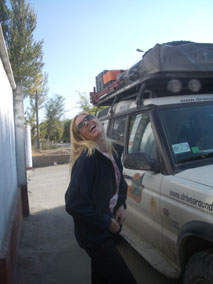
[Chanda hams it up at the Kazakhstan/China border. Strut your stuff, girlfren!]
We pushed on to the China/Kazakhstan border, and we got through with little trouble. We had to wait several hours for them to return from their lunch break, but it was smooth sailing from there. The change from China to Kazakhstan was drastic. This new country reminds us of late70's/early 80's U.S.A., and we really like it. It's difficult to navigate because of the funny writing on the street signs, but we managed to find a hotel with the help of a taxi driver, and we're all jammed cozily into a double-occupancy room at the Hotel Almaty. (N.O.)
| Logbook for October 19th, Day 354 | ||
|
Start: Jinghe, China Time: 9:23 a.m. N: 44* 36.185 E: 082* 53.161 |
Finish: Almaty, Kazakhstan Time: 12:00 a.m. N: 43* 15.021 E: 076* 56.705 |
Mileage: 358 |
October 20, 2004
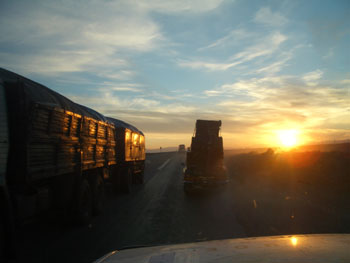
[The road to Almaty, in Kazakhstan. We headed due West (almost) from the border to reach Almaty.]
We worked on getting our Russian visas today, but the embassy closed the door for the day as soon as we were next in line. Rats. But Chanda and Todd received help from a travel agency, and we'll have our visas soon. We might be able to leave by Friday. So, we rested today and then went out to explore Almaty's night life. Not bad. We heard some bands play American music. (N.O.)
| Logbook for October 20th, Day 355 | ||
|
Start: Almaty, Kazakhstan Time: N/A. N: 43* 15.021 E: 076* 56.705 |
Finish: Almaty, Kazakhstan Time: N/A N: 43* 15.021 E: 076* 56.705 |
Mileage: 000 |
October 21, 2004
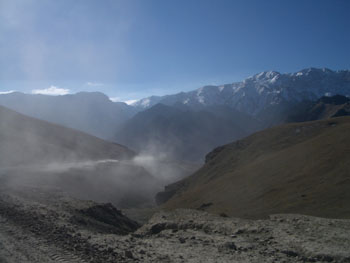
[This was taken in China, near the Kazakhstan border.]
The Russian consulate (baby embassy) is closed today, so this was a rest day. We all had a family-style dinner tonight. Tomorrow, we resume visa work. (N.O.)
| Logbook for October 21st, Day 356 | ||
|
Start: Almaty, Kazakhstan Time: N/A N: 43* 15.021 E: 076* 56.705 |
Finish: Almaty, Kazakhstan Time: N/A N: 43* 15.021 E: 076* 56.705 |
Mileage: 000 |
October 22, 2004
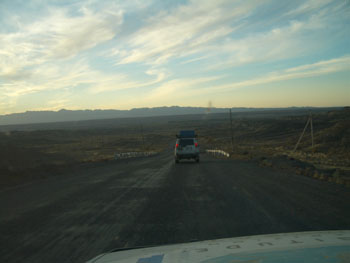
[Heading to the Kazakhstan border, through China.]
Tried to get our Russian visas, again. We waited outside from 0900-1230, again. They wouldn't let us in, again. The gate guard was a real piece of work. I'd like to teach him a thing or two about manners, but he's a lot bigger than I am. We had luck with Pastor Green's family, and we met his daughters, who are in a band called "Shades of Green." They're all Texans, and one of their friends (who was also at lunch) is a former Marine AND a Texan, so of course Nancy felt at home. The rest of the crew felt like vomiting, but that's nothing new. After lunch, Nick and Todd went back at 4:00 p.m. and strong-armed the little consulate guy into issuing us some visas. So, finally, we are all set!(N.O.)
| Logbook for October 22nd, Day 357 | ||
|
Start: Almaty, Kazakhstan Time: N/A N: 43* 15.021 E: 076* 56.705 |
Finish: Almaty, Kazakhstan Time: N/A N: 43* 15.021 E: 076* 56.705 |
Mileage: 000 |
October 23rd, 2004

[Our new guide, Ivan. Ivan lives in Novosibirsk, and he has agreed to ride there with us. How cool is that?]
It has become apparent that we will need to have an interpreter to make traveling through Kazakhstan and Russia possible. We called around to try to find one this morning, then we went shopping at a large local market. We were looking for warm gear for Siberia. Had some luck, but it wasn't a complete success. While packing to leave in the evening, Nick met Ivan Birukov, a Michelin sales rep from Novosibirsk, outside in hte parking lot. His client, Tyres Plus, aligned our wheels while Ivan considered our offer to join the team for the drive to Novosibirsk. After dinner and a few beverages, Ivan agreed. YEA! He's awesome, and we desperately need him. Welcome aboard, Ivan! (N.O.)
| Logbook for October 23rd, Day 358 | ||
|
Start: Almaty, Kazakhstan Time: N/A N: 43* 15.021 E: 076* 56.705 |
Finish: Almaty, Kazakhstan Time: N/A N: 43* 15.021 E: 076* 56.705 |
Mileage: 000 |
October 24, 2004
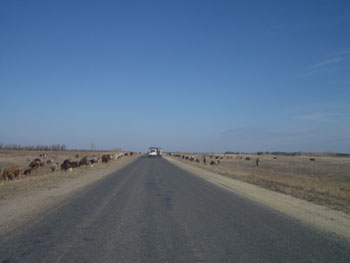
[The road to Russia. ]
We had a slow start this morning because we had Internet work to do, and then we had a difficult time navigating out of the city. Lots of traffic. Nancy had the good fortune of driving with Ivan, and he has proven himself invaluable already. The roads here are well-paved, but bumpy. Curious locals asked about our expedition at every stop (who are you, where are you from, what are you doing?), and they all wished us success and luck. We arrived in Semey very tired. We're really, really, REALLY grateful for Ivan. (N.O.)
| Logbook for October 24th, Day 359 | ||
|
Start: Almaty, Kazakhstan Time: 9:50 a.m. N: 43* 15.021 E: 076* 56.705 |
Finish: Semey, Kazakhstan Time: 2:30 a.m. N: 50* 24.906 E: 080*15.598 |
Mileage: 673 |
October 25, 2004
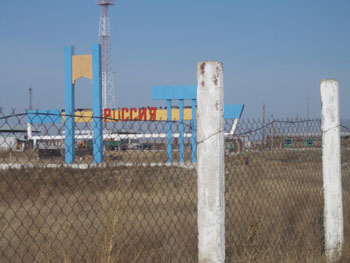
[The Russian border. So close, but so far away. It took us 12 hours (+) to enter the country.]
Ivan earned his stripes today; we all did. We had a slow fuel-up in Semey before hitting the road. The spare tire is breaking off of D3, so we strapped it to the roof. We arrived at the Kaz/Russia border at about 12:30, and then we spent the rest of the day and much of the night trying to cross it. Russia wouldn't accept our carnet/registration/etc. At 4:45 p.m., they DID accept a hefty bribe...It took forever to get out of there, and it is a very long story. They were going to make us travel several hours to another border. Anyway, we finally left the Russia border after heavy expenditures of our precious cash, at about 11:00 p.m. We hadn't eaten or used the bathroom all day, so we immediately stopped at a local restaurant for chow and relief. Dinner was pleasant, with live Russian music, and Ivan did a good job helping us order. Dinner was followed by the longest hotel search in our history, and we finally hit the rack at about 2:30 a.m. Oh, and the hotel charges foreigners DOUBLE! So far, this country is testing our resolve at every corner. We're standing fast. (N.O.)
| Logbook for October 25th, Day 350 | ||
|
Start: Semey, Kazakhstan Time: 10:20 a.m. N: 50* 24.906 E: 080*15.598 |
Finish: Rubtsovsk, Russia Time: 1:45 a.m. N: 51* 31.140 E: 081*12.777 |
Mileage: 093 |
October 26, 2004
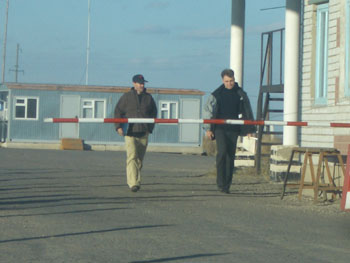
[Ivan and Nick returning from negotiations at the border yesterday. Returning victoriously, this is where Ivan (and Nick, too) really earned his stripes. Couldn't have made it without him.]
We had a great start with a delicious, food-kitchen-style Russian meal. The borsch here is incredible, and so is the bread. We had heard Russian food was bland and blah, but we find the meat-and-potatoes meals to be absolutely delicious and reminiscent of home. We drove straight, paved, bumpy roads through countryside that looks like West Texas (fields and pine trees) until we reached Novosibirsk. We were all happy to arrive, but we're so sad to bid farewell to Ivan. He's happy to return to his wife and daughter, but he admits he'll miss life on the road with us. He said he feels like part of the team already, and that makes us quite happy. See, he IS part of the team. And for this part of the journey, he has been the most important member of our team. Without him, we'd still be at the border. This isn't exactly goodbye, as we'll see him in a couple of days for dinner. (N.O.)
| Logbook for October 26th, Day 361 | ||
|
Start: Rubtsovsk, Russia Time: 10:02 a.m. N: 51* 31.140 E: 081*12.777 |
Finish: Novosibirsk, Russia Time: 8:00 p.m. N: 55* 01.785 E: 082* 55.022 |
Mileage: 093 |
October 27, 2004
[Nick and Nancy with our new friend, business owner Eric, from Wisconsin. He owns a lot of businesses here in Novosibirsk, and he's offered to help us find a guide and some publicity.]
Hello, friends and loved ones. This is a quick posting to let you know we are all safe and sound in Novosibirsk, Russia. So far, traveling in this country, wonderful and friendly as it is, is full of challenges and problems. It took us more than 10 hours to cross the border, and that is easily our longest on record. Luckily, we were traveling with Ivan Birukov, a Novosibirsk resident and Michelin representative whom we met in Almaty, Kazakhstan. He's been our hero since we convinced him to come along with us on Day One. Without him, we'd still be at the border begging and pleading. Now, we are having our vehicles readied for the Siberian winter, and the fine folks at Land Rover Novosibirsk are kindly helping us with that task. We'll leave here the day after tomorrow to continue north to Irkutsk. It's a long drive, and it's a cold drive, and we PROMISE you we are being careful. Safety is our first objective, and we will not attempt something that we perceive as too hazardous. We'll change our route if we have to, etc. Anyway, that's all for now. There's much work to be done here, and I must go. We're looking forward to receiving Land Rover guests in Irkustsk, and they will be with us to help out and capture some stories until we reach Magadon and the end of our Russia leg. Debbie, Mary Beth, and Manrico, we can't wait to see you!
Today, we brought the vehicles in to Land Rover Siberia. The guys and gals there are great, and they are hooking us up, big time.
In the evening, we met Eric, an American businessman living in Novosibirsk and owner of 20+ restaurants and businesses in the area. He's great, and he might be able to help us find a guide. (N.O.)
| Logbook for October 27th, Day 362 | ||
|
Start: Novosibirsk, Russia Time: N/A N: 55* 01.785 E: 082* 55.022 |
Finish: Novosibirsk, Russia Time: N/A N: 55* 01.785 E: 082* 55.022 |
Mileage: 007 |
October 28, 2004
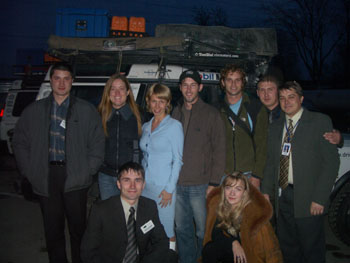
[The team with the gang from Land Rover Siberia. These guys are awesome!]
Journal by Nancy
We brought our Land Rover Discovery expedition vehicles into Land Rover Siberia's service center yesterday, and they're still helping us out today. The people here are incredible, and they are busy readying our vehicles for the Siberian weather. This is one of the coolest Land Rover centers we've ever visited! The people here have wonderful hospitality, and we just love them. They are already becoming our fast friends. Thank you, LR Siberia!
This evening, we had a night out with our new guide, Roma Golovin and his fiance old guide Ivan Birukov and his wife, plus friends from Autoland Siberia, Max, Slava, Kate, and Vitaly. We met Roma through Eric's employee, Slava. Given that Roma is getting married November 27th, we're lucky fiance Maria is allowing him to come along with us... A great time was had by all. (N.O.)
| Logbook for October 28, Day 363 | ||
|
Start: Novosibirsk, Russia Time: N/A N: 55* 01.785 E: 082* 55.022 |
Finish: Novosibirsk, Russia Time: N/A N: 55* 01.785 E: 082* 55.022 |
Mileage: 000 |
October 29, 2004
 <
<[Former guide, Ivan (left), meets new guide, Roma (right). Ivan gave Roma the good news and the bad during our night out on the town.]
Here in Russia, we have made many very dear friends. There's a business owner in town who hails from the U.S., and we went to his club, New York Times, here in Novosibirsk to meet our new guide, Roma, to say farewell to our former guide, Ivan, and to thank our Land Rover heroes from Autoland Siberia. It was a wonderful evening, and everybody had fun. But it was also sad, because with friends this great, we hate to leave. We'll spend one final day in the city, and then we'll head north. Eric, the business owner, is generously helping us with publicity, so we'll take photos and do a couple of interviews tomorrow. (N.O.)
| Logbook for October 29th, Day 364 | ||
|
Start: Novosibirsk, Russia Time: N/A N: 55* 01.785 E: 082* 55.022 |
Finish: Novosibirsk, Russia Time: N/A N: 55* 01.785 E: 082* 55.022 |
Mileage: 000 |
October 30, 2004
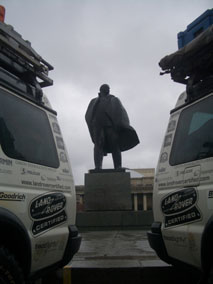
[Novosibirsk. We'll miss this awesome city, and I think at least a few of us will be back to visit. It's a great town.]
I just realized that today is exactly 365 days, one full year, since we began our journey! It's hard to believe... Anyway, I just wanted to let you all know that we picked up our vehicles from Autoland (Land Rover) Siberia today, and we said goodbye to our friend there, Vitaly. We'll miss you, Vitaly. We'll miss all of you. We also said goodbye to his co-worker, Kate. I hate to leave, and I think my teammies would agree that this is a difficult goodbye. I, for one, am practically crying. I hate goodbyes... We'll be traveling to Irkutsk for a couple of days, and e-mail will likely be impossible. Don't worry about us. We'll chat when we reach the city. There, we get to meet up with Land Rover friends and journalists! Until next time, much love from your Drive Around the World crew! Happy Halloween! (N.O.)
| Logbook for October 30th, Day 365 | ||
|
Start: Novosibirsk, Russia Time: N/A N: 55* 01.785 E: 082* 55.022 |
Finish: Novosibirsk, Russia Time: N/A N: 55* 01.785 E: 082* 55.022 |
Mileage: 006 |
October 31, 2004
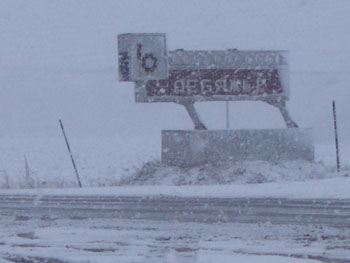
[It was a winter wonderland the day we left Novosibirsk.]
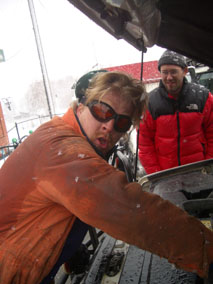
[Todd gets funky under the hood when a funny noise was heard in D2. The noise was a loose bolt.]
We left Novosibirsk today, really early, in the snow, and then we had to turn around and go back. One hundred and twenty-three kilometers outside of town, we realized we had a loose bolt somewhere in our engine, and we had to go to Land Rover to fix it. They fixed it right away (thanks Max, Slava, Vitaly, and Yank), and we were on our way a little after 3 p.m. That made for a long day, and we drove as far as we could on snowy, icy roads before pulling off at a crappy little hotel. No flushing toilet, no shower, smelly running water, one too few beds for the 5 of us, but all is well. (N.O.)
| Logbook for October 31st, Day 366 | ||
|
Start: Novosibirsk, Russia Time: 7:04 a.m. N: 55* 01.785 E: 082* 55.022 |
Finish: Marinsk, Russia Time: 2:04 a.m. N: 56* 11.950 E: 087* 53.223 |
Mileage: 436 |
November 01, 2004
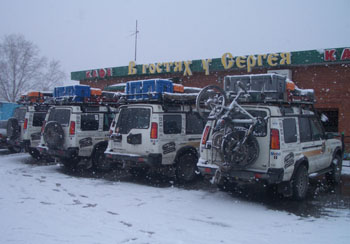
[A winter scene: The Certified Land Rovers outside of a diner in Siberia...]
Well, we're not yet finished for the day, but I thought I'd write while we have the chance. We still have 1000 km to travel before we reach Irkutsk, and we won't have Internet until then. It's about 5 p.m. here, and we'll put in a few more hours of driving. The roads have been fair, with lots of slick icy spots. Now, though, they are improving, for now, and there's no ice. But it's COLD. We're being super careful, and we're looking forward to meeting up with Take Me With You! guests Debbie, Mary Beth, and Manrico in Irkutsk.
We picked up some good karma this morning by jumpstarting a stranded car. It's cold here, and being stranded is NOT good. (N.O.)
| Logbook for November 1st, Day 367 | ||
|
Start: Marinsk, Russia Time: 9:54 a.m. N: 56* 11.950 E: 087* 53.223 |
Finish: Kansk, Russia Time: 11:39 p.m. (12:39 local) N: 56* 12.518 E: 095* 42.309 |
Mileage: 366 |
November 02, 2004
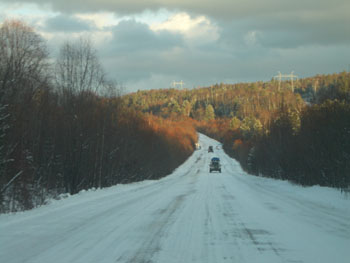
[The roads here in Russia are snowy and icy.]
Long drive today over REALLY icy roads. Nick had a spinout, but all is well. Stopped a few times for coffee and borsch. This is difficult driving, and it's making our team of 5 (Nick, Todd, Adam, Nancy, Roma) really tight. Pushed all the way in to Irkutsk, searched fruitlessly for a hotel, and ended up staying in our cars in a parking lot. Brrr. It's cold... (N.O.)
| Logbook for November 2nd, Day 368 | ||
|
Start: Kansk, Russia Time: 9:20 a.m. N: 56* 12.518 E: 095* 42.309 |
Finish: Irkutsk, Russia Time: 5:46 a.m. (12:39 local) N: 52* 17.324 E: 104* 18.415 |
Mileage: 499 |
November 03, 2004
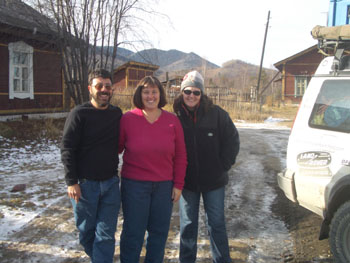
[Take Me With You! guests (left to right) Manrico, Mary Beth, and Debbie. It was great meeting up with them in Irkutsk! Finally!]
Slept a couple of hours in our cars in a parking lot. Drove to a car wash and a fuel station on our way to the Sun Hotel to meet our guests. Met Debbie, Manrico, and Mary Beth there. Soo happy to see them. We did some outdoor-market shopping with Roma's help, and Debbie and Nancy bought some boots. Later, we had a very good dinner together at a local dive. (N.O.)
| Logbook for November 3rd, Day 369 | ||
|
Start: Irkutsk, Russia Time: 7:45 a.m. N: 52* 17.324 E: 104* 18.415 |
Finish: Irkutsk, Russia Time: 12:00 p.m. N: 52* 17.324 E: 104* 18.415 |
Mileage: 006 |
November 04, 2004
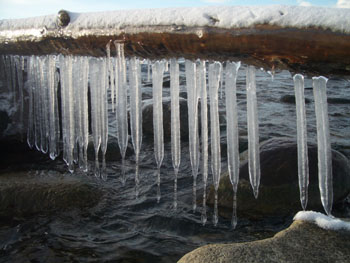
[Icicles on the shores of Lake Baikal.]
We arrived in Irkutsk, the four of us and our awesome guide, Roma, yesterday. (Without him, we'd be sunk.) We're leaving this morning for the long drive past lake Baikal to Yakutsk. We've met up with Debbie from Land Rover and freelance journalists Manrico and Mary Beth. It'll be a fun trek through Siberia with this extended team. All our best to you; we'll update when we can!
We got on the road with Manrico and Mary Beth in D3, Nancy and Adam in D2 for filming, Todd and Roma in the lead in D4, and Nick and Debbie in D1. We visited beautiful Lake Baikal and had lunch on its shores. Roads icy, but not at all bad. Not slick, really. We also had long clear stretches of no ice. Beautiful day. (N.O.)
| Logbook for November 4th, Day 370 | ||
|
Start: Irkutsk, Russia Time: 10:30 a.m. N: 52* 17.324 E: 104* 18.415 |
Finish: Ulan-Ude, Russia Time: 9:18 p.m. (12:39 local) N: 51* 50.289 E: 107* 35.638 |
Mileage: 285 |
November 05, 2004
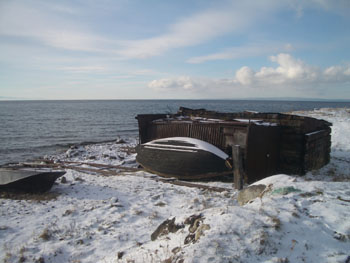
[Another photo from Lake Baikal.]
Highway driving with some snow and ice. Roads actually quite good. Made great time to Chita and checked into a SWEET hotel/casino. Accidentally watched an X-rated show at dinner (honestly, nobody told us about the entertainment schedule). Todd, Nancy, and Roma did an interview with a regional radio station. A few teammies bowled until about 5 a.m. (N.O.)
| Logbook for November 5th, Day 371 | ||
|
Start: Ulan-Ude, Russia Time: 9:00 a.m. N: 51* 50.289 E: 107* 35.638 |
Finish: Chita, Russia Time: 7:00 p.m. N: 52* 04.805 E: 113* 28.950 |
Mileage: 396 |
November 06, 2004
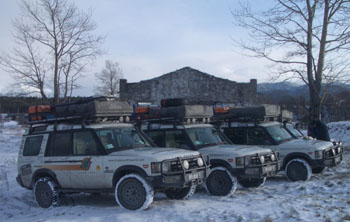
[Vehicles in the snow. (Lake Baikal)]
Paved road ran out and turned into a very new, wide, gravel road. Gravel was better than the pavement, and we made 100 km/h. Scenery reminiscent of NoCal. Cattle, horses, fields, trees. Had a gerry-can refuel just before dark. Also had some really good borsch just before that. Life is good. Tiring, but good. (N.O.)
| Logbook for November 6th, Day 372 | ||
|
Start: Chita, Russia Time: 6:30 a.m. N: 52* 04.805 E: 113* 28.950 |
Finish: Scoborodino, Russia Time: 2:30 a.m. N: 53* 58.550 E: 123* 55.540 |
Mileage: 578 |
November 07, 2004
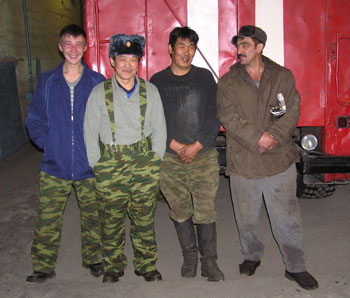
[Our firehouse heroes.]
All went well heading out of town, except that the 1100 km to Yakutsk was double what we expected. Roads slick with snow and ice. Slow-going much of hte way. At Zolotinka, D1 broke a drive shaft, and locals welcomed us into their warm fire station, where their mechanic helped fix the vehicle. These guys were awesome. After several hours with our new firehouse friends, we drove 60 km down the road to the nearest hotel and slept hard. (N.O.)
| Logbook for November 7th, Day 373 | ||
|
Start: Scoborodino, Russia Time: 10:20 a.m. N: 53* 58.550 E: 123* 55.540 |
Finish: Neryungri, Russia Time: 1:30 a.m. N: 56* 40.032 E: 124* 43.509 |
Mileage: 237 |
November 08, 2004
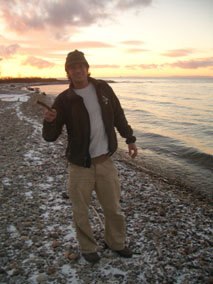
[As we departed Lake Baikal, Adam threough a dread in the water for his buddy, Colin. Colin would have done it himself if he were here. This one's for you, Colin!]
We rolled into Aldan and pulled into a gas station, wehre we met a woman who is friends with the mayor. Later, she introduced us to the mayor. He ended up hooking us up with a garage for the cars and two fully-stocked apartments for the team. We ended up partying with the mayor much of the night, and it was AWESOME! (N.O.)
| Logbook for November 8th, Day 374 | ||
|
Start: Neryungri, Russia Time: 10:43 a.m. N: 56* 40.032 E: 124* 43.509 |
Finish: Aldan, Russia Time: 8:30 a.m N: 58* 36.467 E: 125* 23.261 |
Mileage: 181 |
November 09, 2004
[Red-Light Roma! Guide/translator/teammate Roma Golovin got to take the wheel out by the ferry in Bestyakh. He's a pretty good driver! (Of course, he has driven on ice and snow all his life, right?)]
Had breakfast with the mayor and bid our new friends a fond farewell. He escorted us to the edge of the district, and we were on our way. The roads were all snow-covered and icy. As it got darker, we watched the temperature drop to below -30 C. D4 was in the lead, with Nancy and Roma navigating, and suddenly they came upon a dark shape in the road. They just barely missed running over what turned out to be a Yakutian man in the fetal position, just left of the center of the road. Once the others had caught up, the man was checked for damage and determined to be inebriated. It was well below freezing, and the man had one shoe, no gloves, and no way home. A passing van refused to take him, so the team put him in the back of D4 and brought him to the next police stop in town. They checked him in, and Nancy stuffed a couple of Hella lights in his pocket. Eventually, he'll find them and wonder how in the heck they got there. The team ended up driving to the ferry terminal, where it was determined that the vehicles should be left on this side of the river, and the team would go without them to Yakutsk, on the other side of the river. We pulled a man out of a ditch, and he hooked us up with a great place to stay in a town that supposedly has no hotels. That's karma, baby! We slept well in our warm resort in the woods. (N.O.)
| Logbook for November 9th, Day 375 | ||
|
Start: Aldan, Russia Time: 8:10 a.m. N: 58* 36.467 E: 125* 23.261 |
Finish: Bestyakh, Russia Time: 12:55 a.m. N: 61* 59.855 E: 129* 59.193 |
Mileage: 363 |
November 10, 2004
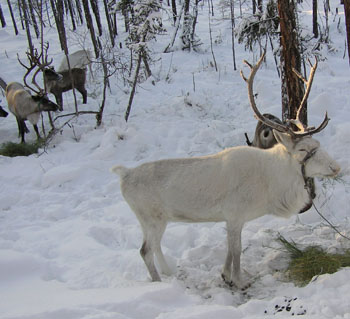
[THIS is where Santa Claus lives! We met some native reindeer in Yakutsk.]
We're here in Yakutsk, finally, and we want to let you all know that we are safe and sound! Actually, we're better than safe-and-sound. We're in a 5-star hotel until tomorrow, and several of us have just purchased fur hats. Fur is the big deal here in Siberia, and it is so natural to see people walking around in it. Seriously, fur is on everybody you see here, and it is a matter of survival. Nothing else will keep these people warm and alive in the frigid temperatures of eastern Russia. The team, our awesome guide, Roma, who is a bonifide team member now, Manrico, Mary Beth, and Debbie, are all doing well in the -20 weather here in Siberia. We apologize for the lack of communication, but it is impossible to find Internet cafes in these desolate places. Finding a gas station is happy enough of an occurrence to keep us motivated. It's funny, but this sort of privileged suffering really makes us proud to be a team, and we feel excited about the rest of our journey. Roma, our guide, is a God-send. Without him, we would be entirely unable to communicate. With him, we have befriended mayors and local know-it-alls who have hooked us up with accommodations and garages for our team and vehicles. Seriously, life is good. Tomorrow, we will very likely spend one more day in these parts working before heading off toward Magadan. We'll try our best to keep you updated as often as possible. We do apologize for the delay in getting word to you. Try not to worry, though, as the roads are good, our vehicles are good, and our spirits are so very high. We miss you all, but we will be home for the holidays...Love and kisses, DATW. (N.O.)
| Logbook for November 10th, Day 376 | ||
|
Start: Bestyakh, Russia Time: 11:35 a.m. N: 61* 59.855 E: 129* 59.193 |
Finish: Yakutsk, Russia Time: 5:00 p.m. N: 62* 10.000 E: 129* 50.000 |
Mileage: 050 |
November 11, 2004
[Nick has a serious meeting with Adam...(Photo taken in Novosibirsk, but we don't have any Yakutsk photos, because Nancy lost Todd's camera...)]
Exploring the town. We went shopping for giant fur hats, and Adam filmed it. Good stuff. Also doing our fair share of exploring the local clubs. (N.O.)
| Logbook for November 11th, Day 377 | ||
|
Start: Yakutsk, Russia Time: N/A N: 62* 10.000 E: 129* 50.000 |
Finish: Yakutsk, Russia Time: N/A N: 62* 10.000 E: 129* 50.000 |
Mileage: 000 |
November 12, 2004
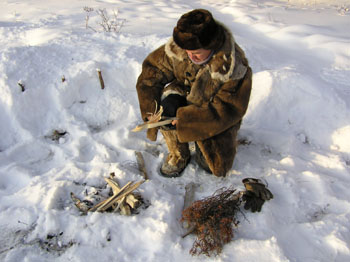
[This native Yakutian taught us about the customs and traditions of the Yakutsk people. Here, he prepares kindling for a fire.]
Hello again from Siberia. Everybody's doing great here, and we're planning to leave in two days. Tomorrow, we will cross an ice river over to the road that will take us to our final destination in Magadan. The next day, we will begin driving again. The drive will take at least 5 days, and we'll most likely have no opportunities for Internet along the way. We'll be driving through reindeer farms, ice rivers, and snow fields, and it will be AWESOME! We could conceiveably be home for Thanksgiving!
Still having fun in Yakutsk. Tonight we had a team dinner, and everybody danced like wackos afterward. I think only Manrico stayed off the floor. Todd stole the night with his "pump-it-up" dance... Todd is a very good dancer, ladies... (N.O.)
| Logbook for November 12th, Day 378 | ||
|
Start: Yakutsk, Russia Time: N/A N: 62* 10.000 E: 129* 50.000 |
Finish: Yakutsk, Russia Time: N/A N: 62* 10.000 E: 129* 50.000 |
Mileage: 000 |
November 13, 2004
[Our new guide, whom we refer to as Roma II. He's Yakutian, and he speaks several languages, including the native Yakutian dialect, Russian, and Chinese. He's excited to come along on the journey, and we're excited to have him. Of course, we'll all be sad to say "see you later" to Roma I. Welcome aboard, Roma II!!!]
We met our new guide, whom we call Roma II, and he's gonna be great. Roma I has to return home tomorrow to get married! Wedding's on the 27th. We spent the morning at a reindeer farm, where we learned about native Yakutian customs. Then we did some quick food shopping before hopping into two Russian 4X4 van taxis to travel back across the ice to Bestyakh. I must say, travelling over tiny icebergs across a frozen river is pretty spooky. And bumpy. We made it back safely and checked into our lodging place, called "The Sanitarium." (N.O.)
| Logbook for November 13th, Day 379 | ||
|
Start: Yakutsk, Russia Time: N/A N: 62* 10.000 E: 129* 50.000 |
Finish: Bestyakh, Russia Time: 8:30 a.m. N: 61* 59.900 E: 129* 54.466 |
Mileage: ??? |
November 14, 2004
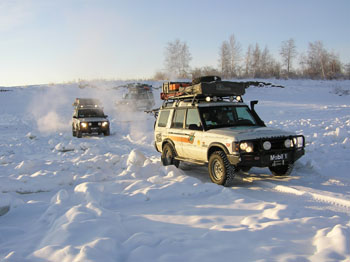
[The vehicles are lined up to cross the ice over the Aldan River. Scary stuff, considering the "road" is not officially open yet...]
We started the morning with a photo shoot with horses near the ferry in Bestyakh, then we discovered a problem with D2's muffler. The cold had cracked a pipe. D2 returned to the garage and worked on it until about 4 p.m. The rest of the team joined them after the photo shoot, and after the repairs, we had to say a very sad goodbye to Roma I. He had to go back across the ice river to Yakutsk to catch his flight, which leaves tomorrow. We are all going to miss him so much! We hit the road with Roma II in the lead vehicle, and we continued through the night and morning to cross the Aldan river and arrive in Khandiga. It was a long day. We're happy to have Roma II with us. (N.O.)
| Logbook for November 14th, Day 380 | ||
|
Start: Bestyakh, Russia Time: 8:30 a.m. N: 61* 59.900 E: 129* 54.466 |
Finish: Khandiga, Russia Time: 1:51 a.m. N: 62* 39.225 E: 135* 34.217 |
Mileage: 296 |
November 15, 2004
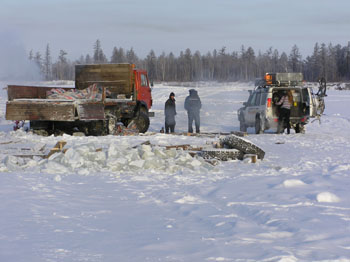
[A diesel truck broke through the ice on the Aldan River and was stuck for more than four days. We offered them food and drink, bt they were confident they'd be out by late afternoon.]
Early-morning wakeup (0615) to backtrack about 40 km to film hte Aldan iver crossing in daylight. After two refuelings in town and an hour or two of filming, the team finally departed for Tomtor. Decent roads to Kubeme, where the road splits (East) for the summer road, and (north) for the "winter road." East to Tomtor, North to Ust-Nera. After finally deciphering the correct spot to cross the river to Tomtor (we had to flag down a local van and ask them), we crossed and found out there's no road to Magadan through Tomtor now. It's closed. Overgrown. Impassable. We gerried up our vehicles and headed north toward Ust-Nera. It was -49 C. We experienced really bad roads all the way north, and then a good road east to Ust-Nera. Along the highway, we saw trees that were right out of Dr. Seuss' The Grinch Who Stole Christmas. It was awesome. And arriving in Ust-Nera after such a long haul was even more awesome. (N.O.)
| Logbook for November 15th, Day 381 | ||
|
Start: Khandiga, Russia Time: 6:45 a.m. N: 62* 39.225 E: 135* 34.217 |
Finish: Ust-Nera, Russia Time: 4:30 a.m. N: 64* 34.120 E: 143* 13.286 |
Mileage: 418 |
November 16, 2004
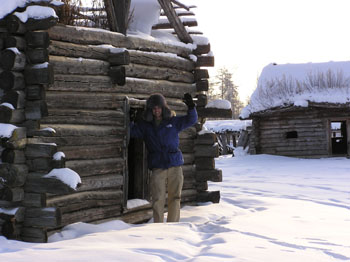
[Adam checks out an old abandoned traditional home near Khandiga.]
Nice send-off and breakfast at the town cafe with new Ust-Nera friends. Fueled up vehicles and gerries. Roads pretty good, and they're getting better. Followed river to susuman and our hotel. Housed vehicles in a nearby garage. The temp. here is colder than -40 C. (N.O.)
| Logbook for November 16th, Day 382 | ||
|
Start: Ust-Nera, Russia Time: 1:34 p.m. N: 64* 34.120 E: 143* 13.286 |
Finish: Susuman, Russia Time: 11:30 a.m. N: 62* 46.596 E: 148* 09.101 |
Mileage: 251 |
November 17, 2004
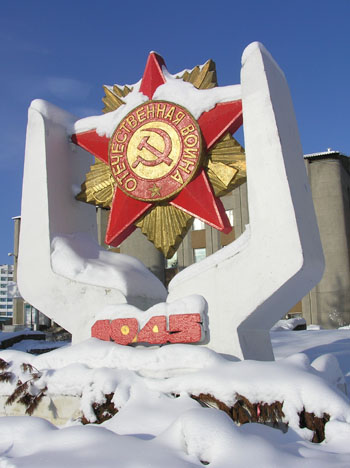
[A sign near Ust-Nera reminds us of Communist days.]
We made it. About 125 km from the finish line, D4's muffler pipe, brittle from the -40 temps, broke. We pulled into the quiet town sounding like a band of Harleys. Getting here was a great feat in teamwork and conviction. Our whole (extended) team really rose to the challenge, and now, here we are. We had nice roads today, but they were dangerously curvy, with a couple of police stops. Manrico, Mary Beth, and Debbie were superstars, and our guide, Roma II, is a Godsend. Nick, Todd, Adam, and Nancy are so thankful for our four newest teammies, and we could not have done it without 'em. Thank you all! To celebrate the occassion, a very tired team of 8 broke open some local beverages and had a hotel party. It's great to be in Magadan! (N.O.)
| Logbook for November 17th, Day 383 | ||
|
Start: Susuman, Russia Time: 1:48 p.m. N: 62* 46.596 E: 148* 09.101 |
Finish: Magadan, Russia Time: 3:00 a.m. N: 59* 38.000 E: 150* 50.000 |
Mileage: 380 |
November 18, 2004
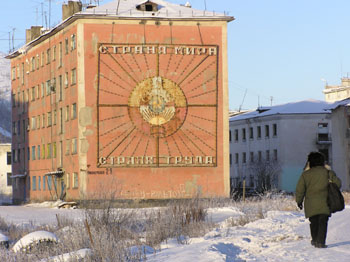
["Signs" of the old communist regime in Russia.]
We had to say goodbye to teammates Debbie, Manrico, Mary Beth, and Adam today, as they had flights to Moscow to catch. Nancy, Todd, and Nick spent the rest of the day with local media and customs. (N.O.)
| Logbook for November 18th, Day 384 | ||
|
Start: Magadan, Russia Time: N/A N: 59* 38.000 E: 150* 50.000 |
Finish: Magadan, Russia Time: N/A N: 59* 38.000 E: 150* 50.000 |
Mileage: 000 |
November 19, 2004
[Adam ties a ribbon to a tree, per Yakutian customs, and makes a wish. I wonder if he wished for safe travels to Magadan and home?]
Hello, friends and family! We've made it safely and soundly to Magadan. The Certified Land Rovers are in a container awaiting shipment to Korea and the U.S., and we are hopping a plane to Moscow on the 20th. We'll be home before you know it to spend the holidays with family before continuing the journey from Alaska. Can't wait to see you all! The roads were long and snowy/icy from Irkutsk to Magadan, and we had so many great adventures. We'll tell you about them when we get home and can sit behind good (free) Internet in the U.S. Love, your LONGITUDE team. (N.O.)
| Logbook for November 19th, Day 385 | ||
|
Start: Yakutsk, Russia Time: N: E: |
Finish: Magadan, Russia Time: N: E: |
Mileage: ??? |